Category Archives: Material

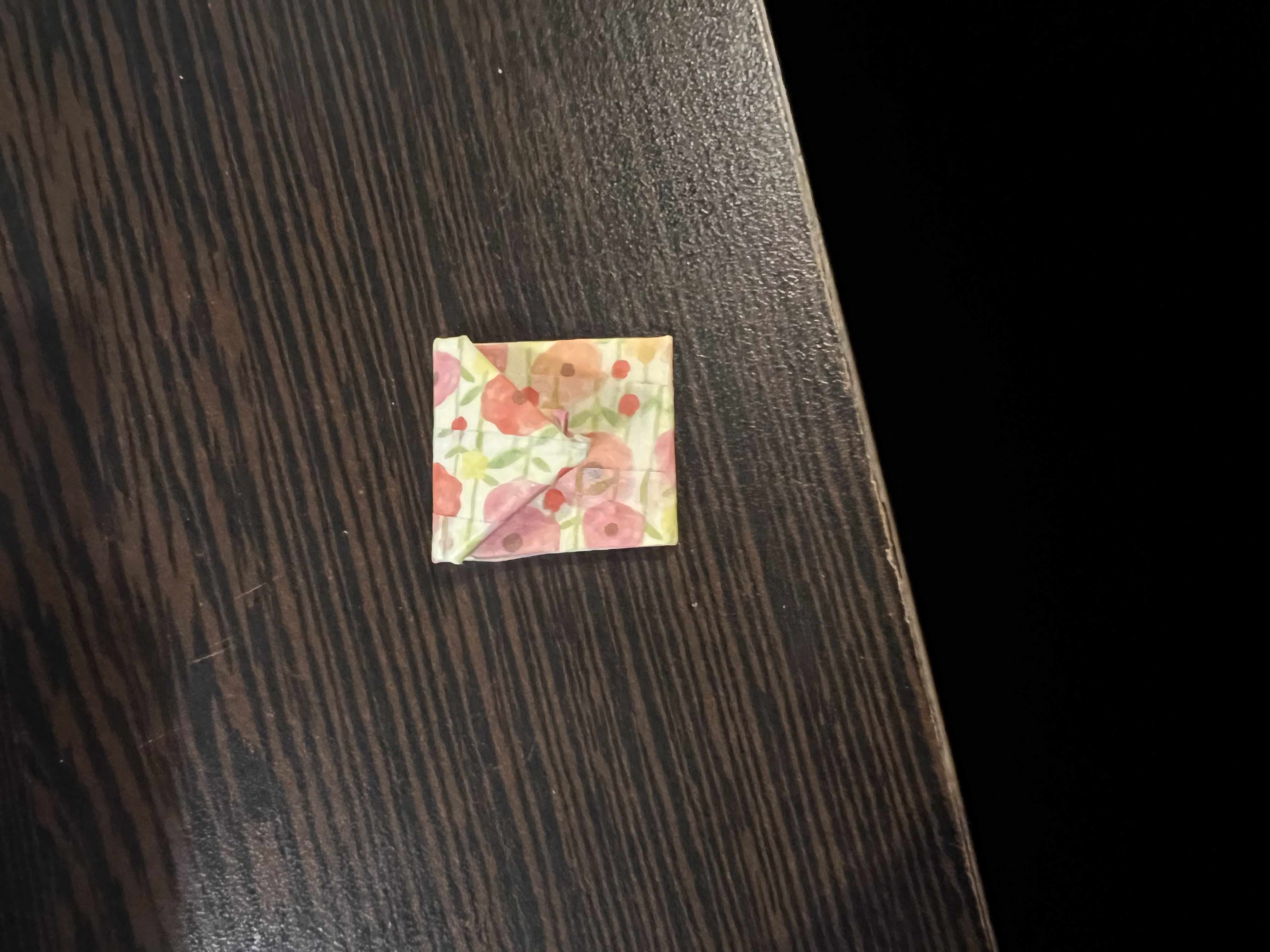
Handmade Envelop Bookmark

Age: 20s

Text:

Context:

Informant-The significance of my envelop bookmark was to encourage me to read since I would decorate them to match the book cover and would leave my personal reviews in them!

Analysis:

The informant spoke to me about the evolution of their bookmarks, how they shared them with friends, and customized them over time. Their process of creating them and showing others how to make them reminded me of origami projects teachers would teach young children, or kids showing each other how to make cootie catchers or paper airplanes in their downtime, during recess, or at camp. Crafts such as these are a way of entertaining oneself with few resources. This craft, in particular, enhanced the activity of reading. These examples of material culture give us insight into what crafts children around the world filled their free time with!

Cures for Colds

Age: 21

TEXT:

Do you have any cures for colds in your family?

Informant: “So when I get a cold, pretty much what we do first is my mom buys eucalyptus leaves and we take a real hot shower with them. Supposedly it’s to help open our lungs. Then my mom will buy some guavas, and it’ll make guava tea. She’ll put cinnamon on it and then once it’s done, we will put in a little help with some honey to help our sore throats and then pretty much just a bunch of rest. And then in our rooms, we will cut half an onion and it’s supposed to help kill the virus.”

CONTEXT:

The context behind these cures for colds, are traditions that the informant has learned from her family who grew up in Guatemala and things that she was raised with.

ANALYSIS:

Though some aspects of these crews for colds can’t technically be proven with science, such as cutting an onion in half to help kill the virus, the belief in the tradition of enacting leaves forms of folk medicine can often serve as a way just to make one feel better within their own mind and thus promote themselves to take better care of themselves to get better faster. Additionally, cures such as guava tea and eucalyptus showers have been specified by this family and culture making it specific to them and those in their community 

Saint Thérèse of Lisieux Relic Changing Colors

Text:

“It all started about 15 years ago. I had a huge devotion to St. Thérèse, and I feel that she’s brought me many blessings in my life, so we were going as a family to France, to Paris for a week, and I realized that St. Thérèse… town where she grew up in was Lisieux, France. So I had an original relic, which is a piece of her bone, which is very rare to get. And that’s called a first-degree relic. I then purchased 25 third-degree relics. A third-degree relic is something that was touched a first-degree relic. So it touched a piece of the bone, the hair, so forth, like that. So I bought 25 of those, and my husband was on the parish council and had a meeting with the priest before we left, so I said, take these 25 with you and have them blessed before we go over to France.

He said, This is ridiculous. This is a business meeting. That would be embarrassing to come in with these, uh, medals. I said, no it’s not. The medal is also a St. Thérèse on one side, and the other side is all red. It’s got a little red circle. So, I said, take these. I said, if you don’t take them, it’s gonna look bad because I already told the priest about them. So he gets them blessed.

I got a rental car, and I said, I’m going to Lisieux. So we go, and we had a private tour, and I took her original relic and put it on the floor of where she lived in this convent. My husband and I had the original. Then we went over to her body, and my one daughter came away from the body, and she said, “Oh my gosh, my, my relic turned white.” And I was like, gosh, that’s strange. We don’t really think anything of it. We had the entire basilica to ourselves.

A neighborhood child had cancer, so I had told the mom I would light a candle in the basilica of St. Thérèse Lisieux for her daughter. So, me and my daughter are over lighting a candle, and my husband is sitting in a pew praying in the front of the church. And as we’re sitting there, lighting the candle, one by one before us, they all started, 16 out of the 25, turned from red to white. And they were just one at a time, and we are just sitting there watching this in awe. So I said to my daughter, go get your father. He comes over. He sees these relics. And he is like, “oh my god”, we didn’t even know what to do.

There was a thing of holy wood. We took all the relics and we threw them in there because, honestly, I was a little scared and overwhelmed, and my daughter was kind of in shock. No one knew what to say. We were all just super quiet. And at the end of it, we took them all out, we dried them, the red ones were still red, the white ones had stayed white. So the, the crazy thing is afterwards, my husband said, I’m not gonna tell anyone this, ’cause we’re gonna look like crazy people. And I said, “well, we do have the before and after, and all of us witnessed it.”

So we do tell people the story now. And since then, as people have gotten ill and things like that, we have given out several of them. Each of the kids have one left. I don’t have that many left because people have been buried with them, or people have come to me and asked for them. I still have my original one, and when someone, if I have a friend who has, like, you know, serious illness or whatever, they usually take it with them to doctors’ appointments and things like that. But, so that is, um, my story of my relics turning, and I think our whole family has a beautiful devotion to St. Thérèse now. My one daughter carries around a little, tiny St. Thérèse statue. It’s maybe two inches high.

Context:

The informant is a middle aged white woman from Philadelphia. She recounts a family trip to the Basilica of Saint Thérèse, a major Catholic pilgrimage site associated with Saint Thérèse of Lisieux. Before the trip, the family had small medals (treated as relics) blessed by a priest. While visiting the convent and basilica, they prayed, placed the relics near the saint’s body, and lit a candle for a sick child back home. During this time, several of the red-colored relics unexpectedly turned white in front of them. In Catholic culture, relics are sacred objects connected to saints. Pilgrimage sites are often associated with miracles or unexplained phenomena, as is her tomb. The experience was emotional and overwhelming, and the family later shared the relics with others, especially those who were ill.

Analysis:

This is an example of material folklore and religious folk belief centered on miracles. The relics act as physical objects believed to carry spiritual power, and the color change is interpreted as a sign of divine presence or intervention. The event reinforces the family’s faith and deepens their devotion to the saint. It also shows how personal experiences at pilgrimage sites can become meaningful stories that are retold, especially when tied to healing.

Cursed Objects on an Arizona Reservation

Text:

Interviewee: “When I was on the reservation, one of the days instead of helping out on the farm and like with the water and everything, they took us to this canyon that was like two hours away.

That’s where we saw those drawings on the mountainsides from the Hopi and earlier groups, and there were also a bunch of houses that were like hundreds of years old.

They also had this thing where a lot of the objects there were kind of like cursed, but only if certain conditions were met. Like, we found some arrowheads in the ground, and we were allowed to pick them up and look at them. But they said if you took them out of the canyon or away from where they were found, you’d basically be cursed and could even die.

It reminded me of how in Hawaii they say if you take rocks from volcanoes you get bad luck. It was kind of like that, on the reservation they said if you tried to take anything off of the reservation, you’d be cursed.

They also had a lot of rules that mainly applied depending on whether you were Native or not. Like, they said there were certain things you can’t do if you’re not Native. There was one example where some of the objects we could hold as non-Native people, but they wouldn’t touch them because they said they would get extremely bad luck. Like one of the arrowheads, none of the Native people were allowed to touch it because it had some kind of history with them, but since we had no relation to it, we were fine.

But then there were other things where we weren’t allowed to touch them or take them home at all, because we as non-Natives don’t really understand the significance.”

Context:

The interviewee was on a service trip to Arizona with school peers. He is a white man aged 18.

During this service trip, he went on a visit to a reservation where the interviewee was spending time with a local community in Arizona and learning about the land, its history, and its cultural practices. The canyon visit included exposure to ancient sites connected to groups like the Hopi, as well as interaction with physical artifacts such as arrowheads. The beliefs about curses and rules around touching objects were explained directly by community members, especially in relation to whether someone was Native or not.

Analysis:

This is an example of material folklore. The idea that objects become dangerous or “cursed” only when removed reflects a magic superstition, where specific actions (like taking an object off the land) trigger consequences. These beliefs discourage people from removing artifacts and help protect culturally and historically significant sites.

The distinction between what Native and non-Native people can or cannot touch shows that meaning and rules depend on identity, relationship to the object, and cultural knowledge. The belief that some objects carry history that affects certain groups differently highlights how folklore is tied to ancestry and cultural connection. Folklore in this story regulates behavior, preserves respect for the land, and reinforces boundaries around cultural understanding and ownership.

Golden Cicadas and Good Luck

“So basically, there were cicadas, especially, like, golden cicadas.

In Chinese culture they are, like, a symbol of good luck, because cicadas, I think are silent for, like, 100 years, or something crazy.

Like, they’re silent for their entire life basically, but then during one, one specific year, they’ll chirp, but it’ll be really loud.

So it’s kind of, like, you’re biding your time, but then, when it’s your time, you can, flourish. That is the kind of vibe.

And so, I’m not sure if this is just something that, like, my parents do, but they always, like, have these little cicada statues, and they are golden.

And I have everything at college, and basically, anytime I have, like, a big test or, like, big, important, decisions or, like, things that I’m, like, waiting for, I’ll just, like, rub the top of its head for good luck.

So I remember when it was college decision time. During that time, we would, me and my sister both, like, sit with it in our lap, basically. But, yeah, we basically just rubbed its head for good luck, and, like, before I take a test, I always do that as well.

I just think that the cicadas represent good luck and, like, prosperity. I think rubbing the statue is just something that’s kind of like a physical thing that you can do to make yourself feel better.

Um, so, yeah. I don’t know if that’s like a real thing, though. She’s something that, like, we’ve always done.”

Context: The informant is a Chinese-Vietnamese-American female USC student whose mother is Buddhist. Although she grew up in the U.S., her family maintains cultural traditions, including keeping small golden cicada statues that symbolize luck and prosperity. Now she has brought a golden cicada to college to continue the tradition.

Analysis: This is an example of folk belief combined with a personal ritual and material culture. The cicada statue itself is a physical object that carries symbolic meaning, representing patience and eventual success in Chinese tradition. The act of rubbing the statue becomes a small, repeated behavior for good luck. Even though she’s unsure if it’s a formal tradition, it still holds meaning for her, showing how folklore can be adapted and maintained across generations.