
Category Archives: Rituals, festivals, holidays

First Communion

Age: 22

Text:
“At my First Communion, they took us up to the practice ceremony with all of our parents upstairs in the church. We had to practice eating the communion, representing the body of christ, and drinking the wine, representing the blood of christ, and we drank the wine. I remember saying, this is so gross really loudly, and my parents got so mad at me. The actual day was really fun. We got to wear our dresses and take pictures outside the church. It meant that I was growing up, and it was a really important milestone for my religion.

Context:
A Catholic girl from Phoenix discussing her First Communion, a coming of age ritual in Catholicism, and what it meant to her.

Analysis:
Her First Communion Served as a signifying moment in her religion, marking the moment that she’s growing up. It took preparation and practice because of how significant it is. She remembers the act vividly, specifically noting that wearing a pretty dress was an exciting part of the event. It’s also interesting how children remember moments of stress, even over moments of pure excitement.
Santa Claus

Age: 22

Text:
“I started to really believe in Santa Claus, and I was very adamant about finding him when he came down my chimney. So I brought out my sleeping bag and put it under the tree and tried sleeping the night under my Christmas tree. My parents got really mad at me and told me that he wouldn’t come if I did that. So I reluctantly went back into my room, and just before I fell asleep, I heard a clomping on the shingles of my roof. To this day, I will never forget the sound of the hoofs, and knowing that Santa was about to come down my chimney. I had so many butterflies.”

Context:
A girl from Phoenix discussing a core childhood Christmas memory that she knows is fake but swears is real.

Analysis:
This is a demonstration of myths serving to keep children well behaved. She believed in Santa and wanted to see him so badly in real life, so she brought her sleeping bag under the tree. Since this is a naughty act, what Santa Claus monitors, her parents were able to use that as a ploy to get her to sleep in her bedroom, saying that he would not come at all if she did not sleep in her room. This served to keep the Christmas magic alive and also to maintain good behavior. I wonder what caused the “hooves on the roof” noise.

Catholic School Christmas Tradition

Age: 22

Text:
“When I was in grade school, I went to a Catholic School, so they taught us about the history and the tradition of Saint Nicholas. Around Christmas time, we would all have a set time where we would put our shoes outside, and then we’d have classes normal. All of a sudden, the teacher would say, ‘Oh! Saint Nicholas was just here. He left you guys gifts.’ We’d go back to the hallway, and our shoes would be filled with candy and gifts.

Context:
A boy from Kansas City, Missouri discussing a Christmas tradition/legend he experienced in his Catholic elementary school, celebrating the holiday through Saint Nicholas.

Analysis:
It is interesting to see that rather than discussing Santa Claus, the more commercial version, the Catholic school was pushing forward Saint Nicholas. It also reminds me of a holiday/tradition that I used to celebrate (a Latina girl from LA), called Dia de Los Reyes Magos, otherwise known as The Three Kings Day, which is celebrated on January 6th, commemorating their long journey to baby Jesus. You place your shoes outside, overnight, and the Kings fill them with candy and gifts. Christmas is typically celebrated with family, so this Catholic school adapted and combined the tradition of Santa bringing gifts and The Three Kings filling shoes with gifts to create a new Christmas tradition each year at this Catholic school.

A Georgian Spring Tradition

Interviewer: Do you remember any special yearly traditions from your childhood?

GM: One thing that comes to mind is chiakokonoba. It’s a yearly tradition around spring where we used to make a very large fire pit and take turns jumping over them. 

Interviewer: Interesting. Tell me more, please.

GM: All the kids in the neighborhood gathered around and competed in who could jump over the largest fire. You can see the appeal; either you make the jump or burn yourself. The adrenaline is what made it fun. 

Interviewer: Do you know where this tradition originated? 

GM: No, but the idea is that it scares evil spirits away. 

Interviewer: Did you believe this when you were participating as a kid? 

GM: Not really. If anything, it angered my mom so much that evil spirits weren’t what I was afraid of anymore. 

Context: The informant was born and raised in Tbilisi, . He often visited his grandparents in the village during spring break, where he used to participate in this tradition. According to him, this tradition is less popular in the urbanized parts of Georgia but still lives on in the more rural areas.

Analysis.

The informant describes a tradition for driving away evil spirits called chiakokonoba (ჭიაკოკონობა). It is interesting that this cleansing from evil spirits happens during a transitional period of early spring. The fire can be seen as a symbolic boundary itself. Facing danger and overcoming fear will cleanse you and protect you from evil spirits. Upon further investigation, I have found that this tradition has pagan roots and now can mostly be found in orthodox Christian countries such as Georgia.

How to Turn a Common weed Into a Weapon

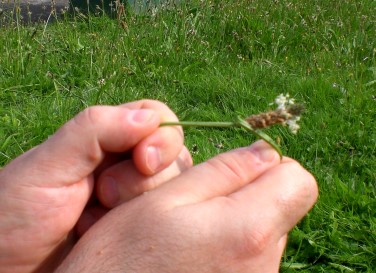
Ribwort Plantain Gun

context:

This is a techniques of turning a common Ribwort Plantain into a catapult. This technique was collected form my grandfather who grew up in Georgia and how to do this when he was very young.

Text:

This is the ribwort plantain, and it is very common in Georgia, where I grew up. My grandfather taught me how to turn one of these into a gun by folding the stem over itself and pulling hard to launch the bulb at the very top. My sister and I had full-on wars where our only artillery was this common weed. My grandpa told me that he himself learned it from his grandfather, so I assume this simple trick is very old. The origin of this practice is unknown, but I assume it exists in most places where this plant grow