
Tag Archives: tradition

George Washington Bridge Song

Text: The George Washington Bridge song is a song that repreats the words “George Washington Bridge” over and over again in rising and falling tunes. 

Context: The informant recalls that this song would be sung by their father whenever they passed over any bridge, not necessarily the George Washington Bridge specifically. The informant originally thought this was a song that their father made up, but the informant’s father notes that he believes he learned it from his father at some point in his childhood. The informant is from Connecticut, but their father is from New York State. 

Analysis: It is performed specifically when crossing bridges, turning an ordinary activity into a ritual. Interestingly, the song is used for any bridge, not just the George Washington Bridge, which shows variation and flexibility. Geography adds another layer. The reference to the George Washington Bridge (a well-known New York landmark) reflects a kind of regional influence, even when performed elsewhere (like Connecticut). This suggests how folklore can carry place-based identity, even when removed from its original setting.
High School theater tradition

Informant: “So in high school theater, we had a lot of traditions before a show. We would always start with some kind of focus activity, which was really nice. Then we’d go around and do a compliment circle, where everyone would give a compliment to someone else.

After that, we’d pass around a “squeeze,” and then the last thing we’d do was this kind of chant-and-movement game. One person would stand in the center and start shouting, “We are riding on a pony, we are riding on a pony, we are riding on a pony…”

Then you’d find a partner, and together you’d do the moves: front, front, front, front—pony; side, side, side, side—pony; back, back, back, back—pony; on a big fat pony.

As it went on, more and more people would join in, and you’d keep repeating it until eventually everyone was doing it together in the final round.”

Context: Informant attended high school in Connecticut and was taught and participated in this theater tradition before their shows. Tradition was passed down from past upperclassmen within the high school program. 

Analysis: This tradition happens right before the performance, which allows actors to mark the threshold between their “normal” life and their staged life. The exaggerated movements and chanting suspend normal behavior, allowing participants to enter a different mindset that is more expressive and less self-conscious.

Additionally, traditions like this are usually passed down from older members of the group to newer ones. This gives older students to pass down to younger ones to continue the ritual as kids age out of the program, but ensures something is left behind by them. 

This also marks who is “in” the folk group of this theater department or ot. Generally, theater communities are known for having their own rituals, superstitions, and games. Participating in these traditions signals membership; if you know the chant and movements, you’re “in” the group.

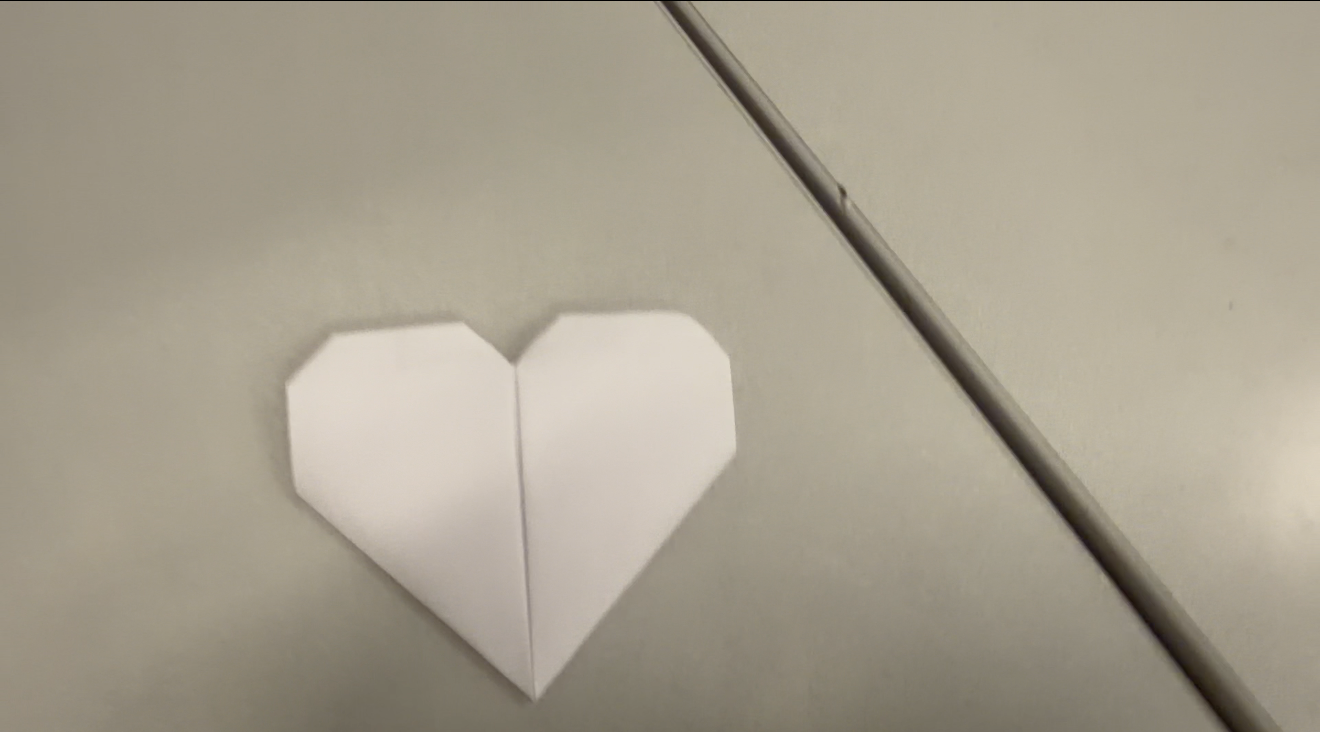
Paper Hearts

Context: The informant learned this art form of paper folding from an elementary school teacher around Valentine’s Day. They were encouraged to fold them and give them to people in their class. However, the informant and her friends continued to make these throughout school and would give them to each other with messages as she got older. 

Analysis: What’s interesting is how the practice of making the paper changes within one person. Initially, it’s a structured activity, everyone learns the same folding technique, and is encouraged to give hearts to classmates. This reflects a kind of guided folk practice, where authority (the teacher) transmits a tradition tied to a holiday (Valentine’s Day). 

After the initial introduction and purpose, it becomes more personal. The informant continues making paper hearts outside of that original setting, which shifts the practice into a more organic tradition. This expands it from being just about Valentine’s Day to being a tradition among friends. 

I also would view this as a form of gift exchange ritual. Even though the object is small and made from inexpensive materials, its value comes from the time, effort, and intention behind it.

Senior Skip Day

Age: 21

Text
“Yeah so every year, I think this is a pretty widely common thing in high schools in like America but like when you’re a senior there will be a day where everybody skips class and it’s called senior skip day. For us, like the high school I went to, it’s pretty much become a tradition where every year the senior class will like meet up and we’ll drink and pregame and all that and then all of us will go to the beach and like hang out for the day. Just like everybody in the class or like anybody that wants to go so like it’s open to everyone and I mean like everybody gets into it because it’s the last few like moments you’re sharing as a group you know. So, yeah, that’s one of the more special traditions I’d say from my high school.”

Context
AV says that senior skip day is a very common and well known tradition among high school seniors in America, and notes that all his friends in college, his siblings, and his high school friends from other schools participated in their own senior skip days at their respective high schools. AV says that at his high school, their specific tradition of drinking and going to the beach as a large group was well known from year to year and nobody really deviated from it. He doesn’t know when it started, but he says a few years later, kids are still doing it now and everybody gets into it.

Analysis
Senior skip day is a piece of customary folklore, a yearly tradition that is widespread throughout American high schools, yet is given its own unique spin by each specific school and student body. It’s a great example of how school lore passes horizontally through students rather than vertically from the institution. It’s a tradition that plays on liminality and communitas, as normal school rules are void (and the school doesn’t mind) and the entire student body is together in experiencing this tradition. For AV’s school specifically, skip day has almost become a festival that marks the end of high school and the social bonds as a graduating class, and according to Santino, intertwines the playfulness of festivals while still marking that transition past high school. Skip day is also a great example of how lore passes down as even though it’s not an official tradition of the school, the same event has been and will continue to be passed from senior class to senior class.

Christian Ritual – Blessings, Bible Verse, Appreciations

Age: 22

Text
“Every day, my grandpa on my dad’s side sends me his blessings and a Bible verse in the morning, and I write it down every day in my notebook and I say three things that I’m grateful for and I also say well like what I guess the Bible like means to me so yeah that’s like a ritual or tradition of my faith that I do.”

Context
Having grown up in a family of devout Christians, IK explains that the daily routine of sending blessings and a Bible verse is one that his grandpa does for all members of his family. For IK personally, he also adds saying his appreciations and the meaning of the Bible to his daily routine as a way to honor his faith and start off each day strong.

Analysis
This is an example of a ritual in IK’s life that exemplifies his belief, which in this case is his Christian faith, and is an example of Kaptchuk’s ritual theory as repeated routines that create some emotional change. It represents a core piece of his family lore that has been passed from his grandfather to every member of his family and that he will continue to share to his kids and grandkids. This ritual also serves a specific function, as for IK the blessings, Bible verses, and appreciations are a way for him to honor his faith before the start of each day and go into each day with the strength of God behind him. For IK, this routine is not just a habit, it is a ritual that serves a specific powerful purpose each morning. As a Christian myself, this story strengthened my place in the Christian folk group because my mom and my grand uncle also send me daily Bible verses, and it’s cool to see that it is a common practice and one that I should continue to honor and eventually pass down to my kids.