
Category Archives: Narrative

The Legend of Chang’e and Houyi

Performance Date: 2/26/2026

CONTEXT:

The performance is a telling of the Chinese legend of Chang’e and Houyi told to me by a Chinese international student at USC, who I will refer to as “EY.” We are sitting together outside of Taper Hall discussing legends. EY goes on to explain the legend and its connection to the Mid-Autumn Festival, along with the cultural beliefs associated with the story.

TEXT:

EY: The legend story I’ll be telling you about is called Chang’e’s legend. It is a Chinese legend um that explains where we have or how we have the Mid- Autumn Festival in mid September in China. Umm so the story basically is about like there’s a goddess whose name is Chang’e who kinda like takes a pill and turns into a rabbit that runs to the moon on the day of mid-autumn festival. Nowadays people in China usually have moon cakes on that festival to celebrate Chang’e.

Interviewer: Oh that’s interesting

EY: So if you look closely at a picture of the moon, there’s a shade that’s in the shape of a rabbit and so people often see that shade as the picture of Cheng’e. The rabbit shape is Cheng’e.

The longer version of the story is mostly about how previously there’s a god called Houyi who kinda shoots the sun in the sky. Chang’e and Houyi get married to each other. Bu then, Houyi was originally supposed to take a pill but he refused to and like the person who asks him to take the pill hides in their home. When Houyi is out and Cheng’e is home, Cheng’e has no other options but to take the pill. When Houyi returns home, he finds out his wife is gone and he’s sad… He might be sad… He must must be sad.

Interviewer: Probably, he’s probably sad.

EY: Yeah, and so the two are separated and Cheng’e is in the sky.

Interviewer: Okay, that’s cool. Do you think there’s like a metaphor, like a meaning behind the story. A meaning that you or your family and friends associate with it?

EY: Yeah, so it’s mostly about nostalgia and separation, I guess. There’s a metaphor in China where we compare the moon to reunion and a happily ever after.

Interviewer: That’s pretty cool, I never thought of the moon as associated with that before.

EY: And so we can associate the moon with romance or reunion in some sense. In Western [Chinese culture] ideas.

Interviewer: I don’t think that’s very common over here. We don’t typically associate the moon with romance. I think I got the story and the meaning behind it. Is there a personal meaning for you that you take on specifically to that story?

EY: I just felt like the look of the rabbit is very interesting. Yeah if you google a picture of the moon.

*looking up a picture of the moon*
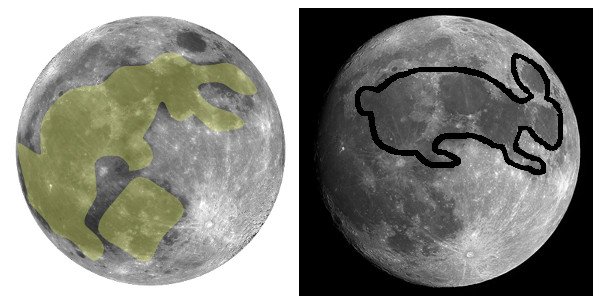
* not the image referenced, but gets the idea*

EY: For example, this part is the rabbit’s head. These two are the ears of the rabbit.

Interviewer: So, I gotta look at it upside down.

EY: Yeah, so this is something that most people don’t usually observe.

Interviewer: Interesting, is that something you can only see at a certain time? Cause there’s different phases of the moon and seasons. Is this something you can only see in September? [The month of the festival].

EY: I guess yeah, but like that time that day is when the moon is like a full moon.

*end of interview

Analysis:

EY explains the story has a significant meaning not just to her, but her family and culture. The story explains the shapes in the moon, gives meaning to culturally significant foods like moon cakes and serves as a fun story to tell. The story is distinctly Chinese and like any cultural story serves as a great reminder for who you are. Without the legend, the mid-autumn festival is really just another holiday. The legend gives the celebration new meaning and amplifies the significance beyond just a fun tradition.

It also gives a standard story to relate to across generations. The culture as a whole can appreciate and enjoy this story. Parents telling their children aren’t just entertaining them. They’re connecting them to their family and culture giving them an identity. It also creates a symbolic meaning that Chinese people can relate to.

EY explained how the story recontextualizes the moon as a symbol of reunion, romance or “happily ever after.” This is interesting because in my culture, the moon doesn’t really mean anything in particular, it’s just the moon. So, to hear how this legend breathes new meaning into the natural world is quite cool. It gives an “everyday” object new culturally significant meaning. In this case, love and reunion. I’m familiar with the idea of roses symbolizing love and affection. But I actually think the moon is better. Unlike a rose, the moon won’t fall apart over time. It might wane, but it always comes back. That makes the reunion and meaning so much more impactful. The same moon can be seen across cities or continents, so it really does connect family and friends. Also, I think there is some more meaning with the moon in that it represents reunion. Every morning, the moon disappears, but we know it’ll come back. That physical movement and repetition adds to meaning that EY explained.

I think that the ritual of eating moon cakes and celebrating during the festival is a way for people to connect with their family, culture, and partners. It’s something that I’ve heard my other friends do, whether they were in China or here in LA. That makes it a cultural signal and reminder of shared belief and identity. It’s given meaning by the story, and eating mooncakes is a way for people to actively participate in that story and culture. The food, story, and importance of the moon itself are great because they can be transmitted anywhere. People can relate to and appreciate that meaning, whether in China or here in America. That story, food, and connection to the moon a ways for people to share their culture without needing to be “at home” for the festival and celebrations. These traditions can be transported and adapted to new regions or environments while maintaining that unique cultural identity.

It’s very interesting to me because, like Houyi, my informant is away from home, separated from loved ones. This must be a very personal story for her, and maybe a very significant one at this moment as well. The legend she chose to share specifically covered longing, separation, and the desire to be together. Whether she meant to or not, the choice to tell that story seems to have been influenced by her feeling away from home; it is probably a way to process her emotions, which is quite cool.

Korean ghost legend

Text:

“The folklore — or legend — I want to share is a Korean ghost legend that I heard from my mom growing up. I heard it when our family first moved to the United States, when I was in second grade, around Halloween.

The story my mom told me takes place in her high school — an all-girls high school back in Korea. In the last stall of the school bathroom, a ghost pops up out of the toilet and asks if you want red or blue toilet paper. Unless you ignore the ghost and walk out, or say you don’t need any toilet paper, you’re not safe. If you choose either option — red or blue — the ghost kills you or drags you down into the toilet with it.

As for where my mom heard the story, she didn’t specify who she heard it from, but there’s a Korean word called quedam, which refers to well-known, typical ghost stories, especially ones set in schools. Korean high schools are large buildings, and they get very creepy at night with the lights off. My mom said a similar legend originated in Japan, among Japanese schoolgirls, and eventually found its way to Korea, where it became widely known across Korean high schools.

The ghost targets a specific group — students — and the story only occurs in a specific location: the last stall of a school bathroom. I don’t think the legend goes into the ghost’s origins. It’s not specific to one high school or one region. I think its purpose is simply to be a scary story that makes you think twice before using the bathroom late at night at school.

Korean high schools have a unique system where, unlike American high schools that end around 3 p.m., students are required to stay at school until late at night — sometimes until 10 p.m. — to study for college entrance exams. So the school gets dark, and that’s exactly the context where these kinds of ghost stories become very relevant.”

Context:

This text was collected from a sophomore civil engineering student at USC. He shared this legend in a recorded interview, recounting a story he heard from his mother when he was in second grade, shortly after his family immigrated to the United States. The legend centers on a bathroom ghost in the last stall of a Korean school, which offers victims a fatal choice between red and blue toilet paper. The informant learned through his mother that the legend likely originated in Japan among schoolgirls before diffusing into Korean school culture, where it became widely known under the broader category of quedam — a Korean term for traditional, well-known ghost stories. The legend is deeply tied to a specific institutional context: the Korean high school system’s requirement that students remain on campus studying until late at night, which creates the dark, isolated conditions that make the story feel plausible and threatening.

Analysis:

This text is a legend: it is set in the real world, targeting a specific location and population, and designed to feel believable rather than fantastical. Thus, Linda Degh’s point that legends function as debates about belief is useful here: the story doesn’t demand full belief, but it enacts enough doubt that a student alone in a dark school bathroom at 10 p.m. might hesitate and feel scared. This is also the legend’s social function; it governs behavior within the folk group of Korean students, creating informal rules around a vulnerable, isolated situation. Moreover, the story’s transnational diffusion from Japan to Korea is a clear example of oicotypification: the core structure travels across borders while adapting to fit the local institutional context of Korean school culture. The legend also does what ghostlore characteristically does: it attaches supernatural danger to a specific, mundane location, transforming an ordinary school bathroom into a site of folk belief. The story’s survival across generations and national borders speaks to its resonance with universal anxieties around isolation, darkness, and vulnerability.


Luka Doncic Trade Consparicy

Text:
“So, me and basically all my friends I grew up with, we’re all huge sports fans. So, a big conspiracy theory that we thought might have been true is about the NBA, which is the professional basketball league. There was a recent trade of a player named Luka Doncic. Basically, one of the best players in the world. He got traded to the Lakers, which is one of the most popular teams. who weren’t doing so well.
Everyone was like, “How did they agree to this?” And what’s even crazier is that a few months later, the team that traded Luka Doncic got the number one overall pick, which is like, it was like a really valuable thing that they just lucked into by a one percent chance. So the conspiracy theory is that because the NBA’s viewership was really down during that period, they kind of forced that team to trade their star player to a big market. 
And in exchange, they can win the lottery to have the best new and young players. I guess the big thing is, at the end of the day, sport is just entertainment. So the theory is kind of questioning the integrity of the league, and like, you know, is it purely just for profit, or do they still have the respect and love for the actual game still.”

Context:

This text was collected from a male college student who grew up in a close-knit friend group bonded primarily through sports fandom. The conspiracy theory centers on two real recent events: the trade of star player Luka Doncic to the Los Angeles Lakers, and the NBA subsequently winning the first overall draft pick at statistically unlikely odds. The informant and his friends circulated this theory informally among themselves, piecing together public events into narratives of institutional manipulation. The informant’s concluding reflection (questioning whether the league retains genuine love for the game) suggests the conspiracy functions less as a firm belief and more as a way for processing disillusionment with a beloved institution he has invested significant emotional identity in since childhood.

Analysis:

This piece is a contemporary legend in a folkloric sense: it is set in the real world, centered on debatable truth claims, and functioning as what Linda Degh describes as a debate about belief. Additionally, the friend group collectively constructing and circulating this narrative exemplifies how proximity and shared experience generate folk belief. The theory also demonstrates the Goliath effect, as blame migrates toward the most powerful institutional player, the NBA itself, rather than individual teams or owners. The league becomes the “villain” in the legend precisely because of its size and commercial dominance. The narrative also carries deep community values around authenticity and integrity in sport, and the conspiracy framework is used to articulate anxieties about cultural hegemony. More specifically, the way that profit-driven culture industries reshape experiences that many folk communities hold as genuinely meaningful. The theory ultimately functions as a form of vernacular resistance, allowing ordinary fans to critically examine an institution that holds significant power over their cultural and emotional lives.


The Frog in the Well

CK: “So there’s a lot of folklore and children’s stories that I read when my mom was teaching me mandarin at home. There’s one that I like a lot and it’s pretty well known, like I feel like all Chinese people know it, it’s called: The Frog in the Well / The Frog at the Bottom of the Well. From what I remember, basically, there’s this frog and he lives a content life at the bottom of a well. He has company (fish and whatnot) and food and whatever you need to be comfortable. One day a turtle comes by the well and tells the frog that he should come out of the well and the frog is like ‘why would I do that lol my life is awesome and I have everything here I need, I have a beautiful view of the whole sky!’ 

Eventually, he’s convinced to hop out of the well and once he does he sees how vast the sky actually is. He realizes how much of the world he doesn’t know about and how much he hasn’t experienced. Yeah, moral of the story is about being open-minded, venturing out of your comfort zone, in general broadening your worldview, making the effort to learn, and discovering opportunities. 

There’s some idioms that come from it.  

井底之蛙 – jǐng dǐ zhī wā – “frog at bottom of well,” you might call someone this if they are close-minded

坐井观天 -zuò jǐng guān tiān – “gazing/looking at the sky while sitting in a well,” same use case as first one but the act of being close-minded

Oh, and a lot of Chinese idioms are 4 characters it’s like a whole thing.””

context: The informant is a Game designer who studied at USC and recently graduated as of 2025. She is a first generation Chinese American and grew up with a lot of Chinese traditions. Her family is from Southern China, and her parents put a lot of effort into teaching her about her culture’s food, language, rituals, etc.

Analysis: Looking at this children’s folktale through a functionalist lens, its meant to enforce a moral function within children. Its advice on how to go about life, and a warning to avoid being close minded. It also pushes children to get out of their comfort zone in order to gain new life experiences. This is further pushed through the multiple proverbs and idioms that come from this specific tale. the phrase “Frog at the Bottom of the Well” is also esoteric language between Chinese people, since they know the meaning behind the phrase due to most Chinese children growing up hearing this story.

The Crocodile Who Walks Like a Man

Age: 20

“On a stormy night a small charter plane was scheduled to land at Boeing Field.

Authorities have never been able to determine who chartered the plane – only that the pilot and passenger were carrying illegal animals into the country.

The plane hit bad turbulence and, after noting the plane losing altitude the radio tower reported hearing a voice in the background yelling something about “it getting out of its cage.”

There was no further radio contact, but a few minutes later the plane tried to make an emergency landing at Paine Field – but failed and went down deep in the woods.

When authorities found the crash site they only discovered the pilot’s body. Coroner’s reports indicated that he died not from the crash impact, but rather from ghastly bite wounds all over his body.

A zoologist from the Woodland Park zoo studied the bites and concluded that they were probably caused by something in the crocodile genus, but with no recorded bite pattern.

Since the crash there have been numerous reported sightings of the crocodile – always at isolated houses or locations deep in the forest.

One such house was originally thought to have been abandoned until clawed footprints were discovered in the flowerbed outside a shattered second story window.

The footprints – hind legs only – were soaked in aviation fuel leading authorities to speculate that the croc may well have mutated from long years of exposure to the runoff waste from Paine Field and the Boeing manufacturing facilities.

But the company denies any such possibility and insists that such stories are merely malicious rumor designed to slander their good name.

this is the story of The Crocodile Who Walks Like a Man that my dad would tell me and my siblings as kids.”

Context: The informant is from Washington state, which is home to many Cryptids. This could be due to the amount of wilderness that surrounds the state. The informant has shared that her father grew up hearing multiple wilderness cryptid stories, and he passed these stories to her when she was a kid. She considers herself a superstitious person, and believes in many of the cryptid stories she was told growing up.

analysis: This legend is a clear statement about how manufacturing facilities around wildlife is dangerous and harms the local communities around them. Its a warning about the predatory nature of big companies, and how little they care for the general publics health as well as the wildlife around them. In a literal sense, these facilities cause massive pollution and harm to the surrounding environment and the animals. There’s paranormal consequences to allowing these companies to invade, pollute and deforest. Its a classic example of folklore used to comment on an institution or company.