Text: The performance captured below is an explanation of different lucky and unlucky numbers in Chinese folk belief.
Interviewer: Do you have any superstitions or things that bring luck?
Interviewee: Yeah, so for uh, again for Chinese people, we have lucky numbers and unlucky numbers. For some reason that I am not super sure about, the number eight is a lucky number. It, like, signifies good fortune, or whatever, and the number four is an unlucky number. I think the last time I hear it, it’s like because (sǐ 死) in Chinese kind of sounds like death, so that’s uh like why.
Context:
The interviewee is an Asian-American student at USC whose parents are first-generation immigrants from China. First, the student was asked if he held any superstitions, after a while of thinking, his response was as described above. When asked how he engages with this belief, the interviewee responded:
Interviewee: Unconsciously I always try to do things, like in eights probably. Like, if I think about it, throughout my life, like, I do feel like eight’s a lucky number.
Analysis:
These examples explain how language affects folk belief. The belief follows the pattern of homeopathic magic, as due to the fact that 4 phonetically sounds like the word for death in Mandarin, negative folk beliefs and superstitions are placed on top of that number. This example also exemplifies how different cultures vary in how they view specific numbers. The additional belief that 8 is a lucky number showcases conversion magic, as now that the evil number 4 is doubled, its unlucky connotation is inverted, and the new number 8 now carries good luck. The response from the interviewee also showcases how belief exists on a continuum. He does not actively advocate that 8 is actually lucky. However, this cultural superstition still subconsciously affects him, and informs how he acts day to day.
Text: Below is a performance from a student describing a Birthday tradition.
Interviewer: Are there any superstitions you know or follow for certain events?
Interviewee: Yeah, so uh, in my family especially, anytime there is, like, a birthday for someone, we eat noodles for their birthday, and, if it’s like my dad’s birthday, we and my family’s whole small family will eat noodles because noodles are, like, long, and that long shape of noodles signifies, like, longevity.
Context:
This excerpt came from a conversation with a 26-year-old grad student who grew up in Walnut, California, and whose parents are both Chinese immigrants. He partakes in this ritual when he or one of his family members celebrates their birthday.
Analysis:
This folk tradition of eating noodles reflects the very common role of food consumption in folk traditions, where a food is consumed for its characteristics. Other examples of this include eating coin-shaped objects for wealth in Lunar New Year, and eating fish for fertility. Here is showcased the sympathetic magical effect of food in folk tradition, as the person eating the food magically takes on the qualities of the food they consume.
The performance is a telling of the Chinese legend of Chang’e and Houyi told to me by a Chinese international student at USC, who I will refer to as “EY.” We are sitting together outside of Taper Hall discussing legends. EY goes on to explain the legend and its connection to the Mid-Autumn Festival, along with the cultural beliefs associated with the story.
TEXT:
EY: The legend story I’ll be telling you about is called Chang’e’s legend. It is a Chinese legend um that explains where we have or how we have the Mid- Autumn Festival in mid September in China. Umm so the story basically is about like there’s a goddess whose name is Chang’e who kinda like takes a pill and turns into a rabbit that runs to the moon on the day of mid-autumn festival. Nowadays people in China usually have moon cakes on that festival to celebrate Chang’e.
Interviewer: Oh that’s interesting
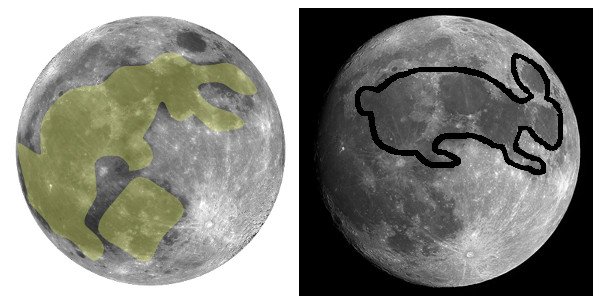
EY: So if you look closely at a picture of the moon, there’s a shade that’s in the shape of a rabbit and so people often see that shade as the picture of Cheng’e. The rabbit shape is Cheng’e.
The longer version of the story is mostly about how previously there’s a god called Houyi who kinda shoots the sun in the sky. Chang’e and Houyi get married to each other. Bu then, Houyi was originally supposed to take a pill but he refused to and like the person who asks him to take the pill hides in their home. When Houyi is out and Cheng’e is home, Cheng’e has no other options but to take the pill. When Houyi returns home, he finds out his wife is gone and he’s sad… He might be sad… He must must be sad.
Interviewer: Probably, he’s probably sad.
EY: Yeah, and so the two are separated and Cheng’e is in the sky.
Interviewer: Okay, that’s cool. Do you think there’s like a metaphor, like a meaning behind the story. A meaning that you or your family and friends associate with it?
EY: Yeah, so it’s mostly about nostalgia and separation, I guess. There’s a metaphor in China where we compare the moon to reunion and a happily ever after.
Interviewer: That’s pretty cool, I never thought of the moon as associated with that before.
EY: And so we can associate the moon with romance or reunion in some sense. In Western [Chinese culture] ideas.
Interviewer: I don’t think that’s very common over here. We don’t typically associate the moon with romance. I think I got the story and the meaning behind it. Is there a personal meaning for you that you take on specifically to that story?
EY: I just felt like the look of the rabbit is very interesting. Yeah if you google a picture of the moon.
*looking up a picture of the moon*
* not the image referenced, but gets the idea*
EY: For example, this part is the rabbit’s head. These two are the ears of the rabbit.
Interviewer: So, I gotta look at it upside down.
EY: Yeah, so this is something that most people don’t usually observe.
Interviewer: Interesting, is that something you can only see at a certain time? Cause there’s different phases of the moon and seasons. Is this something you can only see in September? [The month of the festival].
EY: I guess yeah, but like that time that day is when the moon is like a full moon.
*end of interview
Analysis:
EY explains the story has a significant meaning not just to her, but her family and culture. The story explains the shapes in the moon, gives meaning to culturally significant foods like moon cakes and serves as a fun story to tell. The story is distinctly Chinese and like any cultural story serves as a great reminder for who you are. Without the legend, the mid-autumn festival is really just another holiday. The legend gives the celebration new meaning and amplifies the significance beyond just a fun tradition.
It also gives a standard story to relate to across generations. The culture as a whole can appreciate and enjoy this story. Parents telling their children aren’t just entertaining them. They’re connecting them to their family and culture giving them an identity. It also creates a symbolic meaning that Chinese people can relate to.
EY explained how the story recontextualizes the moon as a symbol of reunion, romance or “happily ever after.” This is interesting because in my culture, the moon doesn’t really mean anything in particular, it’s just the moon. So, to hear how this legend breathes new meaning into the natural world is quite cool. It gives an “everyday” object new culturally significant meaning. In this case, love and reunion. I’m familiar with the idea of roses symbolizing love and affection. But I actually think the moon is better. Unlike a rose, the moon won’t fall apart over time. It might wane, but it always comes back. That makes the reunion and meaning so much more impactful. The same moon can be seen across cities or continents, so it really does connect family and friends. Also, I think there is some more meaning with the moon in that it represents reunion. Every morning, the moon disappears, but we know it’ll come back. That physical movement and repetition adds to meaning that EY explained.
I think that the ritual of eating moon cakes and celebrating during the festival is a way for people to connect with their family, culture, and partners. It’s something that I’ve heard my other friends do, whether they were in China or here in LA. That makes it a cultural signal and reminder of shared belief and identity. It’s given meaning by the story, and eating mooncakes is a way for people to actively participate in that story and culture. The food, story, and importance of the moon itself are great because they can be transmitted anywhere. People can relate to and appreciate that meaning, whether in China or here in America. That story, food, and connection to the moon a ways for people to share their culture without needing to be “at home” for the festival and celebrations. These traditions can be transported and adapted to new regions or environments while maintaining that unique cultural identity.
It’s very interesting to me because, like Houyi, my informant is away from home, separated from loved ones. This must be a very personal story for her, and maybe a very significant one at this moment as well. The legend she chose to share specifically covered longing, separation, and the desire to be together. Whether she meant to or not, the choice to tell that story seems to have been influenced by her feeling away from home; it is probably a way to process her emotions, which is quite cool.
“One tradition we have during Chinese New Year is that it is necessary to wear new clothes from top to bottom. So like inner clothes, pajama, and new bed sets, new slippers, new socks, and new everything. And then, we have to all clean our room and house by ourselves, since we can’t get housekeepers to do it for us, so it’s necessary to do it by ourselves. Then, at 12 o’clock midnight, you have to eat dumplings.
Context:
The Chinese New Year is celebrated in China for the first two weeks in the Chinese Calendar. Each day is filled with various cultural and familial traditions. The informant shared her family tradition for the first day of the Chinese New Year.
Analysis:
This tradition can be understood through both symbolic and social frameworks in Cultural Anthropology. Wearing new clothes during the Chinese New Year reflects ideas of renewal and transformation. This aligns with what Arnold van Gennep describes as rites of passage, marking a transition into a new cycle. Cleaning the house oneself reinforces responsibility and participation in maintaining social harmony, which reflects Confucian values of family duty. Finally, eating dumplings together at midnight could bring the family into a shared moment that feels special and unifying. This practice allows everyone to mark the transition into the new year collectively, which reinforces a sense of togetherness and connection.
“When my family members pass away, we have a funeral ritual. When my grandmother passed away, the coffin was first placed on the ground floor of the apartment building. Before carrying her to the funeral parlor, my father had to break a porcelain bowl on the floor and say something he wanted to say to her — usually something short, like ‘may you go peacefully.’ Then the coffin was carried to the funeral parlor.”
Context:
This text was collected from a Chinese international student from Beijing. She recounted the ritual from personal memory, having witnessed it during her grandmother’s funeral. The practice involves two distinct symbolic acts performed before the deceased is transported to the funeral parlor: the placement of the coffin on the ground floor of the family’s apartment building, and the breaking of a porcelain bowl by the closest male family member — in this case, her father — accompanied by a brief farewell address to the deceased. The phrase her father used, “一路走好” (yī lù zǒu hǎo), translates roughly to “may you go peacefully” or “have a safe journey,” a common Chinese expression of farewell to the dead. The informant presented the ritual as standard family practice rather than something unique to her household, suggesting it reflects broader Beijing or northern Chinese funeral customs transmitted through family participation rather than any formal or institutional instruction.
Analysis:
This piece is a customary ritual operating at the intersection of material culture and folk belief, and it demonstrates Van Gennep’s rites of passage framework. The funeral ritual stages the deceased’s transition out of the living world through two carefully sequenced symbolic acts. The breaking of the porcelain bowl follows the logic of sympathetic magic, more specifically the contagious variety, where the destruction of a physical object in the shared space of the living enacts a spiritual severance, which could formally close the bond between the deceased and the household. The ground floor placement of the coffin before departure further emphasizes this threshold symbolism, positioning the body literally between the domestic space of the living and the outside world before the final transition to the funeral parlor. The father’s spoken farewell, “may you go peacefully,” functions as folk speech with ritual authority, a fixed phrase whose repetition across generations gives it vernacular power.