
Category Archives: Life cycle

Camp Birthday Song

Age: 21

Text:
“Happy, happy birthday. What? Birthday. What? Happy, happy birthday. What? Birthday. What? Everybody knows that it’s your day, so we’re gonna celebrate in the best way. All your friends, no families here. This only happens once a year. Happy, happy birthday? What? Birthday. What?”

Context:
A girl from NYC who learned this song at sleep-away camp, where she spent her summers growing up.

Analysis:
This song is passed down each year from camper to camper during birthday celebrations. It is sung in unison and also features a matching clap “dance” to create the rhythm. This rendition of the Happy Birthday song was made to cater to campers who may or may not be homesick and need to be reminded that they area surrounded by all their friends and having the best time. The song is interactive and dynamic, making the birthday celebration all the more exciting.
First Communion

Age: 22

Text:
“At my First Communion, they took us up to the practice ceremony with all of our parents upstairs in the church. We had to practice eating the communion, representing the body of christ, and drinking the wine, representing the blood of christ, and we drank the wine. I remember saying, this is so gross really loudly, and my parents got so mad at me. The actual day was really fun. We got to wear our dresses and take pictures outside the church. It meant that I was growing up, and it was a really important milestone for my religion.

Context:
A Catholic girl from Phoenix discussing her First Communion, a coming of age ritual in Catholicism, and what it meant to her.

Analysis:
Her First Communion Served as a signifying moment in her religion, marking the moment that she’s growing up. It took preparation and practice because of how significant it is. She remembers the act vividly, specifically noting that wearing a pretty dress was an exciting part of the event. It’s also interesting how children remember moments of stress, even over moments of pure excitement.

How to Turn a Common weed Into a Weapon

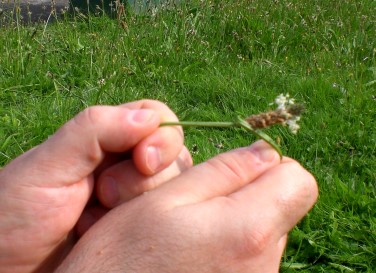
Ribwort Plantain Gun

context:

This is a techniques of turning a common Ribwort Plantain into a catapult. This technique was collected form my grandfather who grew up in Georgia and how to do this when he was very young.

Text:

This is the ribwort plantain, and it is very common in Georgia, where I grew up. My grandfather taught me how to turn one of these into a gun by folding the stem over itself and pulling hard to launch the bulb at the very top. My sister and I had full-on wars where our only artillery was this common weed. My grandpa told me that he himself learned it from his grandfather, so I assume this simple trick is very old. The origin of this practice is unknown, but I assume it exists in most places where this plant grow

Birthday Spanking

AZ: In my family we do birthday spanks. You get one swat for every year you’ve been alive, plus one to grow. My dad usually does it while we’re all standing around the cake before we blow out the candles.

“Interviewer: I know this is a common folk ritual, however is there anything your family specifically does to modify this practice?

AZ: Now that you mention It we make sure to do the spankings at the exact hour the person was born, in order to “spank” them into the next chapter of their life”

Context: This is a multi generational family tradition passed down from her paternal grandfather. To AZ, this is a nostalgic and grounding ritual. While the act is playful, the family takes the timing seriously. The added later of the timing transforms a general game into a practice of family law. She views the physical sensation as a necessary “spank” into her new age.

Analysis: This ritual is another example of how folklore can be localized through variation and a secular rite of passage. However, the specific modification AZ describes, performing the ritual at the exact hour of birth, elevates the practice from a general custom to a sacred domestic event. Anthropologically, this emphasizes the importance of liminality. This is also connected to sympathetic magic, and the physicality of the action in the present propels the individuals journey into the future.

Telling the Bees

LH: In my families old farm in the Midwest, whenever a family member passed away someone had to go out to the backyard and ‘tell the bees’. You have to knock on each hive and whisper the name of the person who died. If you don’t tell them, the bees,

Context: The informant is a close friend, and he learned this folklore through ancestral tradition through the maternal line, originating from English Immigrants who settled in the Midwest. We were disscssing ecology for another class when he told me this story. To the informant, this custom represents a deep “ecological contract” in which his family is keeping the bees in the loop because they regard them as family due to their facilitation of plant life. Its an honor code as they believe the bees deserve to be a part of the mourning process.

Analysis: Telling the bees is a profound example of a folk custom that illustrates animism, the attribution of living should to plants, inanimate objects, and animals. The ritual serves a vital functioning purpose in the grieving process: it forces the bereaved to step outside the domestic sphere and engage with the natural world, providing a structures, meditative task during a time of emotional chaos. Historically, this piece of folklore responded to the high stakes of rural survival. The loss of bee colonies is a significant economic blow, highlighting how some folklore practices arise out of necessity,