
Category Archives: Life cycle

The Shotgun

Age: 21

Collected 4/22/2026

Context:

My roommate, who is of Irish-American descent, told me the story of when he first went shooting. We met in high school and have been friends for about 8 years now. He told me in our apartment kitchen after asking about his family traditions.

Text:

His family first immigrated to New York in the 1800s. About a century later, he told me that his great-grandpa bought a “classic Baretta double-barreled shotgun like you’d see in Red Dead” for hunting ducks in Maryland. Nowadays, my roommate and his dad often go hunting in the woods in Montana, and he fondly remembers that core memory with his dad of when he first learned to shoot.

My roommate told me that back when he was 15, his dad took him to a gun range in Lake Piru, California, to learn how to shoot. The event wasn’t specifically on his birthday or any particular day, as he can remember. But it was sometime soon after he turned 15. In his family, “each male for the last 3 generations has learned to shoot the same double-barreled shotgun.” The shotgun is a family heirloom that he suspects his Irish immigrant great-great-grandfather bought, for hunting and it’s been passed down steadily from father to son.

While at the range, his dad started with gun safety. Essentially, just the basics, like “don’t aim it at people or things you don’t wanna shoot.” He also learned to respect the weapon, “don’t treat it like a toy,” and not to throw it around or handle it roughly. As far as he knows, the shotgun has been largely kept in good condition, and most, if not all, of the parts are original. The wood stock and grip are lacquered with oils to keep it clean and in good condition. When it finally came time to shoot, his father showed him how to stand and helped him aim. When he pulled the trigger, the gun went off, but he found out that it was loaded with a blank. He told me that he and his dad first shot a blank to get a feel for the recoil.

After handling the recoil, he began to shoot at the clay pigeons launched in the air at the range. He said his dad wanted to teach him how to hunt, so moving targets were a great way to get into it. After shooting, he explained that his dad showed him how to clean and take care of the gun. Later, when he turned 18, he was allowed to have his own gun under different state laws. He hasn’t shot the shotgun since; it serves as a ceremonial piece.

I asked him if there was a specific time or moment when he learned, but he can’t remember. But he did say it was a moment when he started to feel more grown up. He told me that his sister also learned how to shoot. He couldn’t say whether she got the exact same treatment. But their father took her to a local range and taught her to shoot the same shotgun.

I asked if he would continue the tradition. He told me “that he plans to “of- course man.” The shotgun will be passed to him and he plans to pass it to his kids when they’re born and ready. He feels that the passing of the shotgun and the instruction in how to shoot are a metaphor for life. He and his family “value being responsible and self-sufficient.” He said it felt pretty special to be the fifth in his family to hold and shoot the gun. As the sole male child and heir to the family name, he felt it was a really special moment to step into the shoes that his family had left. To fulfill expectations and continue the legacy.

Analysis:

This was a cool story to hear; my roommate hadn’t told me about it before, and I’ve known him for around 8 years now. It was a pretty nice story and makes sense because his family has a strong military background dating back 3 generations. Shooting, hunting, gun safety, and responsibility are all very important to him and to his family.

I think the ritual serves three main functions besides bonding. The first and more obvious is that the ritual serves as a lesson in gun safety. It’s a father teaching his son how to properly hold and shoot a weapon. He learned discipline and responsibility, and it made him interested in the responsible use of weapons at a young age. It teaches real safety skills for young people and taught him the power and potential danger of weapons.

I think an equally important purpose for this event is to serve as a passing of the family legacy. Family is a big thing for him; he cares a lot about that lineage and is proud of where he comes from. The fact that the same gun has been used by all the males in his family says a lot. It is their legacy, their transition into adulthood, and their father passed that legacy to him so he could learn what it means to be a male in their family. His sister also learned and got the same experience. But my roommate said she isn’t as interested in the legacy, shooting, or the shotgun as he is. Also, he will inherit the weapon, not his sister. By learning with that gun, he is an active participant in that tradition and now a part of that shared family history. He remarked that it felt really special to him to be part of that. I asked him, and he explained that he did have a connection to that story. But for him, the most important thing it did for him was teach him responsibility.

The gun itself is also a physical representation of that legacy. It has existed for over a century and serves as a marker of his family. Sure, other guns exist, but this is his family’s gun. He adds meaning to it by using it, continuing that legacy, and being interested in teaching his children how to shoot that gun.

A final, deeper meaning is that the lesson served as a rite of passage for young men in his family. In a way, it created a liminal space to help facilitate the transition of children to young men. The lessons it taught him about weapon safety carry over to real life. Being disciplined, respectful, self-sufficient, and responsible are all qualities that he holds dear. He and I agree that those values probably stem from the family’s deep military history. Those are all imparted to him through that event.

It’s also interesting to me that I just found out about this. I knew he knew how to shoot, but I didn’t know it was such a significant family tradition. I know a lot about him since we’ve known each other for 8 years, but that story seems to be sacred and personal. It’s also funny because at first glance, my friend doesn’t look like someone who would have traditions. He grew up in a suburban neighborhood in what our other roommate would call a “boring” neighborhood. But this just showed me how much folklore and culture are lying just under the surface. I’ve known him for so long, but all I had to do was ask, and it seemed there was more to my friend that I hadn’t learned.

It also challenges my pre-existing notion that folklore is foreign or unique to a specific identity. Folklore is all around us; we just forget to pay attention because it’s “normal” or we’re used to it. I mean, this is a dude who’s got red, white, and blue coursing through his veins, and yet he has some great traditions. This is just a great reminder that folklore is often studied from a distance because the stuff close to us blends so well into our daily lives.
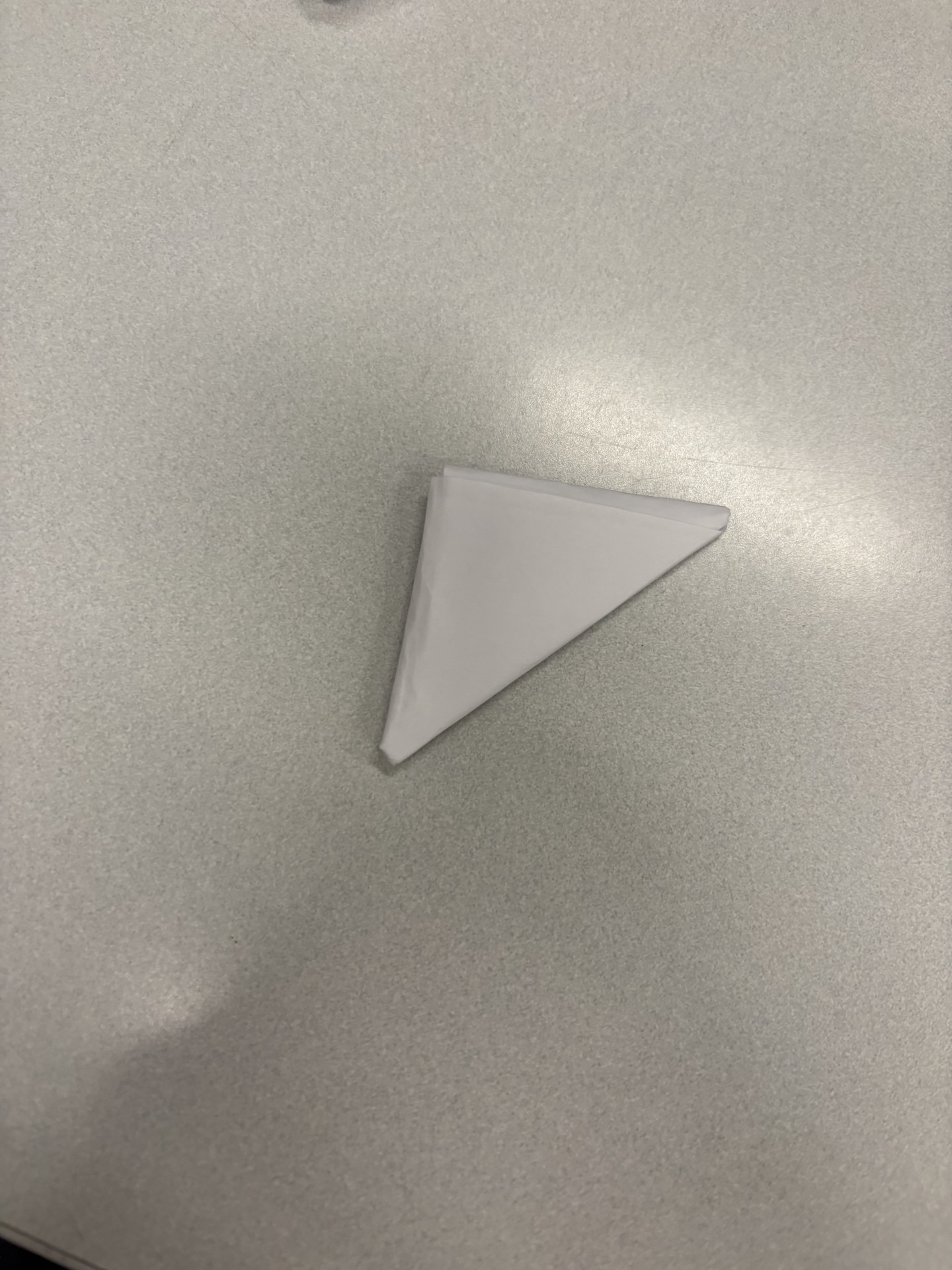
Folded Paper Football

Age: 20

Collection Date: 04/09/2026

Context:

During an in- class activity, my informant showed me how to fold a standard piece of paper into a football that he used to play small desk games with friends as a child. He said said that he learned this in elementary or early middle school and often created these footballs while bored in class. It was a fun way to stay busy and play with friends when class allowed it.

Text:

My informant repeatedly folded a standard 8×10 piece of printer paper, ensuring tight, straight folds with no unnecessary creases. The shape is formed by folding triangles into one another, making the final product dense and sturdy. My informant used an older YouTube video for assistance to remind him of some of the steps. He demonstrated the folding process and explained key details, such as the aforementioned tight folds, minimal creases, and common mistakes people make when folding them.

The final result is the Paper football pictured above, which can be used to play a fun game with a friend. Each takes a turn: one holds their fingers in the shape of a goalpost, the other positions the football in a punting position by holding the top corner and pushing down so it stands vertically. The “kicker” then flicks the football, propelling it forward into the goal. The player who gets five goals first wins.

Analysis:

It is interesting that he called it a football. I had never heard it called a paper football before, but when he showed me the process, I immediately knew what he was talking about, which I called a “paper triangle.” It’s funny, because I also learned how to make those from friends back in elementary school. These kinds of foldables often appear when we’re supposed to be learning, paying attention, or otherwise doing something else. Due to their location, students had to be somewhat sneaky when creating or playing with them, keeping them hidden from the teachers.

It is also a perfect representation of school children’s folk art. It is an item made informally from mass-produced materials, that’s taught from student to student, or unofficially online, and holds no monetary value. However, it does hold sentimental and nostalgic memories for the children and communities who grew up with these.

It is also interesting how he used some assistance from a random YouTube video. This reminds us that folklore continues to thrive online. There wasn’t one specific “right” video. Although the end product is roughly the same, each creator has a slightly different way of folding the paper or presenting the instructions, giving the process variety. Even though the digital tutorial exists, he still showed me in person how to make it, and the details (described earlier) he added were quite interesting and different than what the video did or could have mentioned.

Chinese Funeral Ritual

Text:

“When my family members pass away, we have a funeral ritual. When my grandmother passed away, the coffin was first placed on the ground floor of the apartment building. Before carrying her to the funeral parlor, my father had to break a porcelain bowl on the floor and say something he wanted to say to her — usually something short, like ‘may you go peacefully.’ Then the coffin was carried to the funeral parlor.”

Context:

This text was collected from a Chinese international student from Beijing. She recounted the ritual from personal memory, having witnessed it during her grandmother’s funeral. The practice involves two distinct symbolic acts performed before the deceased is transported to the funeral parlor: the placement of the coffin on the ground floor of the family’s apartment building, and the breaking of a porcelain bowl by the closest male family member — in this case, her father — accompanied by a brief farewell address to the deceased. The phrase her father used, “一路走好” (yī lù zǒu hǎo), translates roughly to “may you go peacefully” or “have a safe journey,” a common Chinese expression of farewell to the dead. The informant presented the ritual as standard family practice rather than something unique to her household, suggesting it reflects broader Beijing or northern Chinese funeral customs transmitted through family participation rather than any formal or institutional instruction.

Analysis:

This piece is a customary ritual operating at the intersection of material culture and folk belief, and it demonstrates Van Gennep’s rites of passage framework. The funeral ritual stages the deceased’s transition out of the living world through two carefully sequenced symbolic acts. The breaking of the porcelain bowl follows the logic of sympathetic magic, more specifically the contagious variety, where the destruction of a physical object in the shared space of the living enacts a spiritual severance, which could formally close the bond between the deceased and the household. The ground floor placement of the coffin before departure further emphasizes this threshold symbolism, positioning the body literally between the domestic space of the living and the outside world before the final transition to the funeral parlor. The father’s spoken farewell, “may you go peacefully,” functions as folk speech with ritual authority, a fixed phrase whose repetition across generations gives it vernacular power.


Chinese Birthday Tradition of Longevity Noodles

Text:

“For everybody’s birthday, we have to wear new clothes from top to down. And then we also need to eat noodles each morning, and your whole family also needs to eat noodles with you. And then you also need to like use a chopstick to drag the noodles as long as possible (like hold it as long as possible). And say something like “live forever” or something like that. So that can like represent that you are going to be healthy and have like a good life for a very long time. Everyone has to take pictures as they hold the noodles. Even when we are apart, my family still does it and sends it to me on my birthday.”

Context:

The informant describes a family birthday tradition centred on eating 长寿面 (longevity noodles). This is a common practice in many Chinese households. She grew up participating in this ritual with her family, where eating noodles on one’s birthday symbolises wishes for a long and healthy life. The informant explains that this is not only done in person but continues even when family members are physically apart, as they take photos and share them with each other. For her, this tradition is both a symbolic ritual and a way of maintaining family connection across distance.

Analysis:

This tradition can be understood through Mary Douglas’s idea that everyday practices carry symbolic meanings that reinforce cultural values. The emphasis on the length of the noodles reflects how physical actions are used to represent abstract ideas like longevity and health. The act of carefully holding and eating the noodles shows intentional participation to express these wishes. Other than carrying symbolic value, the shared participation (whether in person or through photos) reinforces family bonds and continuity.


The Frog in the Well

CK: “So there’s a lot of folklore and children’s stories that I read when my mom was teaching me mandarin at home. There’s one that I like a lot and it’s pretty well known, like I feel like all Chinese people know it, it’s called: The Frog in the Well / The Frog at the Bottom of the Well. From what I remember, basically, there’s this frog and he lives a content life at the bottom of a well. He has company (fish and whatnot) and food and whatever you need to be comfortable. One day a turtle comes by the well and tells the frog that he should come out of the well and the frog is like ‘why would I do that lol my life is awesome and I have everything here I need, I have a beautiful view of the whole sky!’ 

Eventually, he’s convinced to hop out of the well and once he does he sees how vast the sky actually is. He realizes how much of the world he doesn’t know about and how much he hasn’t experienced. Yeah, moral of the story is about being open-minded, venturing out of your comfort zone, in general broadening your worldview, making the effort to learn, and discovering opportunities. 

There’s some idioms that come from it.  

井底之蛙 – jǐng dǐ zhī wā – “frog at bottom of well,” you might call someone this if they are close-minded

坐井观天 -zuò jǐng guān tiān – “gazing/looking at the sky while sitting in a well,” same use case as first one but the act of being close-minded

Oh, and a lot of Chinese idioms are 4 characters it’s like a whole thing.””

context: The informant is a Game designer who studied at USC and recently graduated as of 2025. She is a first generation Chinese American and grew up with a lot of Chinese traditions. Her family is from Southern China, and her parents put a lot of effort into teaching her about her culture’s food, language, rituals, etc.

Analysis: Looking at this children’s folktale through a functionalist lens, its meant to enforce a moral function within children. Its advice on how to go about life, and a warning to avoid being close minded. It also pushes children to get out of their comfort zone in order to gain new life experiences. This is further pushed through the multiple proverbs and idioms that come from this specific tale. the phrase “Frog at the Bottom of the Well” is also esoteric language between Chinese people, since they know the meaning behind the phrase due to most Chinese children growing up hearing this story.