
Author Archives: Ray Russell

Bengali New Year – Pohela Boishakh

Age: 25

Date Collected 4/21/2026

Context:

A good friend of mine, who immigrated with his family from Bangladesh for college, told me about the Bengali New Year celebration, “Pohela Boishakh” or পহেলা বৈশাখ. He told me about the general celebration and how his family’s celebrations differed from the norm.

Text:

On April 14th, “my family wakes up, we dress in red or white, and eat this fermented rice, mashed potatoes, and hilsa fish.” He explained to me that he thinks the white represents purity, and red represents joy or energy. But to him, the colors really symbolize the spirit of the new year and the celebration of Bangladesh. He tells me that breakfast typically consists of mashed foods, lots of vegetables, and starches, with a single piece of hilsa fish. He explained that the Hilsa fish is Bangladesh’s national fish and a cultural icon. When he was young, his family taught him that’s the way things are done, but he never really questioned it until he came to America and learned about our traditions. He explained that as he got older, his family stopped making the fermented rice (which would actually get you a bit drunk). For them, it was just a tradition that his parents wanted to pass down to him and his sister, “kind of like hunting for easter eggs.”

After the breakfast, the celebration isn’t over. They move to the streets, painted red and white. Parades go through the streets and people celebrate kind of like a big picnic. He explained it was “similar to the Marty Gras,” but without all the alcohol or debauchery. But a similar level of excitement, fun, celebrations and an almost parade like atmosphere. His celebration was quite different from those in the big cities, where they used parade floats and giant symbolic animal heads. In the countryside, things were simpler, and people would set up around the grass at parks and visit each other’s setups. It was a time for old friends to connect. He mentioned his dad’s old soccer friends had a spot at a local park they would revisit every year. Lunch continued the excitement and festivities with street food or barbecue-style setups. The countryside differed from the city in that the focus was on building community rather than on the nation or on symbolic ideas.

The celebration would continue throughout the day and into the night; families return home and enjoy an intimate family meal with fish, lentils, and, of course, rice. He explained that typically, the women would stay back or leave the celebrations early to cook and prepare the family dinner. Sometimes they would be able to take rotations, but unlikely. He explained that in his family, most of the cooking was done the night before, so there was maybe like an hour of work to do, and he would return home to help his mom and sister cook. To him, the festival was patriotic and a way to unite as a community, to remember his identity and beliefs, and honor his family and traditions.

Analysis:

The story was very interesting to me; it sounds similar to the festivals and events I’m familiar with, but at the same time, so different. The rice and a single slice of fish remind me of an almost religious practice because it is so specific and symbolic. But the practice is regional, not religious; people in India, including West Bengal, also celebrate it. I found it funny because my friend is a devout Muslim who refuses to drink when we go out. So, his telling me that the fermented rice got him buzzed had me feeling betrayed. But, he told me that “it’s nothing and doesn’t count as a sin.” This was very interesting and makes me think that aspects of the celebration, like the fermented rice must predate the country’s Islamic influence.

In addition, the meal seems to be a symbolic fresh start to the year. The rice and slice of fish are humble and could represent a simple style of living, or starting the year humbly. The fish, also the national fish of Bangladesh, suggests that including fish conveys national pride and recognition of the country.

My friend also mentioned a lot of details that he wasn’t sure about some of the traditions. He knew what they were and how to do them, but he never really considered why. They were just his way of life. His normal. It wasn’t until he experienced new cultures in coming to America that he began to think about why.

In addition the traditions aren’t static, they adapt. Fir instance he joined his mom and sister in cooking, and as he’s grown older, they no longer eat the rice. This just goes to show how traditions can change over time. As other cultures and norms change, some traditions might be viewed as less important, childish, or outdated, and may be cut or replaced by new traditions.

The costumes (red and white clothing) serve to show who is participating in the holiday. They serve as a physical representation of membership in the folk group, community, and celebration. They have symbolic significance, but my friend didn’t focus on the colors’ meaning. What mattered to him was that the colors represented Bangladesh and, more specifically, the country’s holiday. The same could be said about the hilsa fish and fermented rice. The meaning of each individual piece might not be significant or known to every participant, but the larger cultural meaning of being Bangladeshi and “in” on the tradition is where the meaning lies.

I also found that Dhaka’s procession, animal floats and general celebration style is protected under UNESCO, but not the holiday itself.

After moving to LA, he and his family had to change their traditions even more. He said that the celebrations are fragmented. Despite the large Bangladeshi population in K-town, it seems most celebrations are held at home and don’t last as long as they do back home. This shows how, as cultures and ideas spread to new communities, they must change and adapt to those communities. It seems the Bengali population in K-town is not unified yet to come together as a community and celebrate. But, it could also be because K-town isn’t “home.” His family just immigrated fairly recently, so they don’t have the same communal bonds they had back home. So that could be a factor as well. In LA, the family becomes the folk group, whereas back home, it was the community or even the nation as a whole.
The Shotgun

Age: 21

Collected 4/22/2026

Context:

My roommate, who is of Irish-American descent, told me the story of when he first went shooting. We met in high school and have been friends for about 8 years now. He told me in our apartment kitchen after asking about his family traditions.

Text:

His family first immigrated to New York in the 1800s. About a century later, he told me that his great-grandpa bought a “classic Baretta double-barreled shotgun like you’d see in Red Dead” for hunting ducks in Maryland. Nowadays, my roommate and his dad often go hunting in the woods in Montana, and he fondly remembers that core memory with his dad of when he first learned to shoot.

My roommate told me that back when he was 15, his dad took him to a gun range in Lake Piru, California, to learn how to shoot. The event wasn’t specifically on his birthday or any particular day, as he can remember. But it was sometime soon after he turned 15. In his family, “each male for the last 3 generations has learned to shoot the same double-barreled shotgun.” The shotgun is a family heirloom that he suspects his Irish immigrant great-great-grandfather bought, for hunting and it’s been passed down steadily from father to son.

While at the range, his dad started with gun safety. Essentially, just the basics, like “don’t aim it at people or things you don’t wanna shoot.” He also learned to respect the weapon, “don’t treat it like a toy,” and not to throw it around or handle it roughly. As far as he knows, the shotgun has been largely kept in good condition, and most, if not all, of the parts are original. The wood stock and grip are lacquered with oils to keep it clean and in good condition. When it finally came time to shoot, his father showed him how to stand and helped him aim. When he pulled the trigger, the gun went off, but he found out that it was loaded with a blank. He told me that he and his dad first shot a blank to get a feel for the recoil.

After handling the recoil, he began to shoot at the clay pigeons launched in the air at the range. He said his dad wanted to teach him how to hunt, so moving targets were a great way to get into it. After shooting, he explained that his dad showed him how to clean and take care of the gun. Later, when he turned 18, he was allowed to have his own gun under different state laws. He hasn’t shot the shotgun since; it serves as a ceremonial piece.

I asked him if there was a specific time or moment when he learned, but he can’t remember. But he did say it was a moment when he started to feel more grown up. He told me that his sister also learned how to shoot. He couldn’t say whether she got the exact same treatment. But their father took her to a local range and taught her to shoot the same shotgun.

I asked if he would continue the tradition. He told me “that he plans to “of- course man.” The shotgun will be passed to him and he plans to pass it to his kids when they’re born and ready. He feels that the passing of the shotgun and the instruction in how to shoot are a metaphor for life. He and his family “value being responsible and self-sufficient.” He said it felt pretty special to be the fifth in his family to hold and shoot the gun. As the sole male child and heir to the family name, he felt it was a really special moment to step into the shoes that his family had left. To fulfill expectations and continue the legacy.

Analysis:

This was a cool story to hear; my roommate hadn’t told me about it before, and I’ve known him for around 8 years now. It was a pretty nice story and makes sense because his family has a strong military background dating back 3 generations. Shooting, hunting, gun safety, and responsibility are all very important to him and to his family.

I think the ritual serves three main functions besides bonding. The first and more obvious is that the ritual serves as a lesson in gun safety. It’s a father teaching his son how to properly hold and shoot a weapon. He learned discipline and responsibility, and it made him interested in the responsible use of weapons at a young age. It teaches real safety skills for young people and taught him the power and potential danger of weapons.

I think an equally important purpose for this event is to serve as a passing of the family legacy. Family is a big thing for him; he cares a lot about that lineage and is proud of where he comes from. The fact that the same gun has been used by all the males in his family says a lot. It is their legacy, their transition into adulthood, and their father passed that legacy to him so he could learn what it means to be a male in their family. His sister also learned and got the same experience. But my roommate said she isn’t as interested in the legacy, shooting, or the shotgun as he is. Also, he will inherit the weapon, not his sister. By learning with that gun, he is an active participant in that tradition and now a part of that shared family history. He remarked that it felt really special to him to be part of that. I asked him, and he explained that he did have a connection to that story. But for him, the most important thing it did for him was teach him responsibility.

The gun itself is also a physical representation of that legacy. It has existed for over a century and serves as a marker of his family. Sure, other guns exist, but this is his family’s gun. He adds meaning to it by using it, continuing that legacy, and being interested in teaching his children how to shoot that gun.

A final, deeper meaning is that the lesson served as a rite of passage for young men in his family. In a way, it created a liminal space to help facilitate the transition of children to young men. The lessons it taught him about weapon safety carry over to real life. Being disciplined, respectful, self-sufficient, and responsible are all qualities that he holds dear. He and I agree that those values probably stem from the family’s deep military history. Those are all imparted to him through that event.

It’s also interesting to me that I just found out about this. I knew he knew how to shoot, but I didn’t know it was such a significant family tradition. I know a lot about him since we’ve known each other for 8 years, but that story seems to be sacred and personal. It’s also funny because at first glance, my friend doesn’t look like someone who would have traditions. He grew up in a suburban neighborhood in what our other roommate would call a “boring” neighborhood. But this just showed me how much folklore and culture are lying just under the surface. I’ve known him for so long, but all I had to do was ask, and it seemed there was more to my friend that I hadn’t learned.

It also challenges my pre-existing notion that folklore is foreign or unique to a specific identity. Folklore is all around us; we just forget to pay attention because it’s “normal” or we’re used to it. I mean, this is a dude who’s got red, white, and blue coursing through his veins, and yet he has some great traditions. This is just a great reminder that folklore is often studied from a distance because the stuff close to us blends so well into our daily lives.

Weaving Air – Muslin

Age: 25

Date Collected: 04/30/2026

Context:

My informant is a good friend of mine who immigrated from Bangladesh for his college education. He was telling me about the story of a legendary fabric from his hometown, Dhaka, Bangladesh. He told me when we were hanging out outside of the USC Fisher Museum of Art.

Text:

Me: Okay. So you were telling me a little bit about back home in Dhaka, that’s where the muslin fabric comes from. Right?

EJ: Yeah, thats where its from. There used to be like this whole area kind of like the Arts District in LA like a municipality where they would make this cotton fabric. It’s unique because it was so thin, they called the skill “weaving air” because it was so light and thin, and that’s like one of the things that we’re very proud of culturally. They used to be able to weave it so tight the thread counts were really high. You could fold it up into a matchbox.

Me: You told me earlier that they don’t make it the same anymore right? Can you talk a little more about that.

EJ: Yeah for sure.. I don’t know the whole story, but I just know that it originates from Bangladesh. Dhaka is exactly where it comes from. Dhaka used to be like a hub of culture and and money and then in about sometime in like whenever, the the English colonized it. They took the fabric for their royalty. The royalty and wealthy used to wear this in Bangladesh. The English took it and brought it back home and they cut off the hands of the weavers who would make this fabric.

Me: Jesus. Why do you think they’d do that?

EJ: I think they just didn’t want people who were wearing the same things as their royalty.

Me: Yeah, that sounds like the English hahaha. So there’s no more muslin makers in Dhaka.

EJ: No, not like that. The old ways were lost. After loosing their hands, they couldn’t make any anymore, so they retired and the art was lost.

Me: But, is it extinct?

EJ: No, there’s new places that make them still by hand. But it can’t fit into a matchbox and isn’t the same. They can’t do the same techniques.

Me: Do you have any in your family, or have you seen it before?

EJ: No, I don’t think we have any. But, I’ve been to weddings and they have it there.

Me: That sounds like a terrible thing to accidentally misplace. Oh also earlier you were also showing me that Instagram reel that was kind of showing appreciation for Bangladeshi culture, right? Like how it’s reflected in modern life and also in the future.

EJ: Yeah, yeah, that reel was kind of just talking about how the muslin was used on the first airplane that the Wright brothers flew, and also on the Artemis II, which is really cool.

Me: How do you feel about seeing part of your culture being used by other people? Is it like something that makes you happy or a little upset?

EJ: You know, it’s really cool to see Bangladeshi culture being represented, especially on huge moments in like this.

Me: Yeah, I can imagine there’s a lot of pride in that, cause I mean, this is essentially the future of humanity, and your culture is playing a huge role in that. Man might not have been able to fly or land on the moon if it weren’t for those weavers and your culture’s history.

EJ: Exactly.

Analysis:

I did a quick search to see what is true, and what might be more folklore from the story. From what I could tell, Dhaka is genuinely one of the most impressive textiles ever made. The Wright brothers did not use any Dhaka Muslin; they used an “Americanized” version that was derived from the impressive tradition. The muslin used on the Wright brothers’ plane was taken to the Moon by Neil Armstrong and later to Mars by the Ingenuity rover.

What might be more folkish is that the Wright brothers did not actually use Dhaka’s muslin. Also, the hand-cutting story is not historically verified, but that doesn’t mean it never happened. What is true is the major damage done to the Bangladeshi people as a result of the English colonists.

The history of muslin reflects the beauty and majesty of old Bangladesh. As my friend mentioned, it thrived culturally and economically. Then the English East India Company came and colonized the country. In the process, many fine folk arts were lost. The story of the cutting of hands might be true, but whether it is literal or not, the imagery is symbolic for what the English colonization of Bangladesh did to the Bengali people. The cutting of their hands represents the stripping of culture, practices, and traditions. The legend of cutting hands doesn’t have to be historically accurate to be insightful and meaningful. It is a way to deal with the loss of identity as well. Hands are essential for making a living; they hold our fingerprints and identity. When the English “cut off” their hands, they were cutting off the ability to live and continue as they had before.

My friend had pride in saying that you could fold a full muslin outfit into a matchbox size. The image is impressive and impossible, showing the value of the golden pre- colonial era. The pride in calling it “woven air” seems to stand in for the old ways as a whole. Traditions were lost; they weren’t all perfect, but they were irreplaceable and, most importantly, they were Bangladesh’s. The fact that no one has ever been able to accurately replicate the hand-woven artistry of Dhaka’s weavers once again communicates that something irreplaceable was lost when Bangladesh was colonized.

It’s an interesting choice in story to tell me. I had been asking him for examples of Bangladeshi culture, foods, festivals, stories, jokes, sayings, and more. From all of them, he told me this one, which is quite interesting. When he first told me, he made sure to mention the impact he learned from the Instagram reel. That THIS is his culture and it had an undeniable impact on human history. He didn’t have to explain what the muslin meant culturally, and I didn’t necessarily even need to understand. The story communicates Bangladeshi pride in a way that anyone can understand and appreciate.

Looking at the full arc is quite interesting too. We saw a folk art that was a people’s pride that got stolen by outsiders and used to dress their royalty. The creators were no longer able to make it, and the tradition seemed lost. But centuries later, it was brought into the limelight as part of humanity’s journey into space. The story reframes the tragedy and pain into a story of how Bangladesh made something that monumentally changed human history forever.

Bobotie – South African Dish

Age: 52

Collected 4/18/2026

Context:

My mom immigrated from South Africa to California as a child, growing up she was raised mostly as any other American child in the area would have been. But, to help and her siblings connect with their culture and history, her parents would occasionally cook them all bobotie, a traditional south African meat dish that is kind of like a meatloaf.

Text:

My mom explained, that once every two weeks, her parents would cook her and her siblings foods from South Africa. This wasn’t anything special, “just a nice family dinner to give us a taste of home.” One of the most memorable dishes for her growing up was Bobotie. The recipe originates in the lower Cape, but her family was north-east of Johannesburg, quite a ways from the historical origins. The recipe, as she explained, was fairly common in South Africa; they used a printed poster brought with them when they immigrated, which listed the ingredients and instructions. She says, “that poster is probably still somewhere in their family house.” But, back when her parents were cooking (this was 30-40 years ago) things like curry powder and chutney weren’t available at your local grocery store. So, her parents had to substitute other ingredients. For example, one that she remembered was substituting apricot jam for the chutney. Her family also commonly used raisins, bananas and other fruits to add to the sweet profile of the dish. To her this was normal, but back then, fruits and meat weren’t a common combination in American cuisines. She wasn’t embarrassed though, as she told me “it does remind you that you’re different, but that’s just a thing our family.” For her and her family, it was a way to connect with their roots and pass on some of that identity to my mom and her siblings who grew up primarily in America.

One funny memory my mom mentioned is that her family would sometimes serve the Bobotie to her friends when they stayed over. To most kids, this was a really strange (never-before-seen food). So, to mess with them, my mom and her parents would tell the kids they’re eating elephant stew, which surprisingly worked. Most of the friends she remembered trying it thought it was tasty and quite exotic.

She never really got to try the original until much later in life when visiting her “home town” in South Africa, but by that point, the California Bobotie was the norm. So, when she tried the real thing, she was kinda disappointed. Funny enough, “it didn’t taste nostalgic or like home because it was different.” She can’t remember whether her parents told her that they were substituting ingredients or not, but it didn’t matter. Because to her, the substitutions were the dish.

Analysis:

Before I go into my analysis, I should note my perspective. I grew up with similar cultural exposure. Especially from my mom’s side of the family and my cousins. So, to me some of these things were normal. I wasn’t eating weird foods, but also, I wasn’t raised with as much influence as she was. So to me, these things are somewhat normal, but also somewhat foreign.

One thing from this story that interests me is how the substitutions were forced by a necessity. The ingredients just didn’t exist in common grocery stores, so her family had to create their own “spin” on the dish, which I’m sure wasn’t uniquely their substitution. After a quick Google search, it looks like substituting the chutney is a fairly common thing to do. So many other families in similar situations might have made similar adaptations or substitutions when bringing the food here. My Oupa and Ouma weren’t degrading the dish or making it any less, they were adapting it to their environment so that that culture might continue to exist in their children.

As mentioned, my mom grew up mostly like any other American child. But small things like this are examples of how her parents allowed her to grow up in a new environment while maintaining that cultural identity and connection. And to that effect it worked. She doesn’t remember much else of what they did that was South African, maybe because whatever they did was just “normal” to her growing up that was all she saw. But, seeing and tasting a different food definitely resonated with her.

It’s also so funny that they all leaned into the weird or exotic food aspect. That really sounds in character for my Ouma to mess with someone like that. They didn’t hide the food when friends came over, instead they made it seem exotic by using the unfamiliarity of it. Also, it kind of flipped the roles. Typically, I would have pictured my mom to be embarrassed or nervous for her friends judging the food, but the joke reverses that idea, allowing my family to hold the power in the situation. They’re in on the joke, the other kid, not so much.

But, by far the most interesting piece to me is how my mom mentions that the California Bobotie was just Bobotie. To her, the substitution and “odd” recipe is what she grew up with, so trying the “real thing” felt weird. This shows that there is no one way to do something; instead, it’s in the cultural context and shared meaning that makes it the “right way” or normal. It’s all about perception and experience. The authenticity and connection to the food come from repeated experiences, not just the origin. This highlights the loose boundaries that can make it difficult to categorize or “own” folklore.

This raises a serious question we’ve asked in class. What makes folklore genuine? Well, my mom’s experience would suggest that authenticity is not about adherence, but about shared value and experience. To her, the California Bobotie was more authentic and genuine than any traditional Bobotie could ever be.

Folded Paper Football

Age: 20

Collection Date: 04/09/2026

Context:

During an in- class activity, my informant showed me how to fold a standard piece of paper into a football that he used to play small desk games with friends as a child. He said said that he learned this in elementary or early middle school and often created these footballs while bored in class. It was a fun way to stay busy and play with friends when class allowed it.

Text:

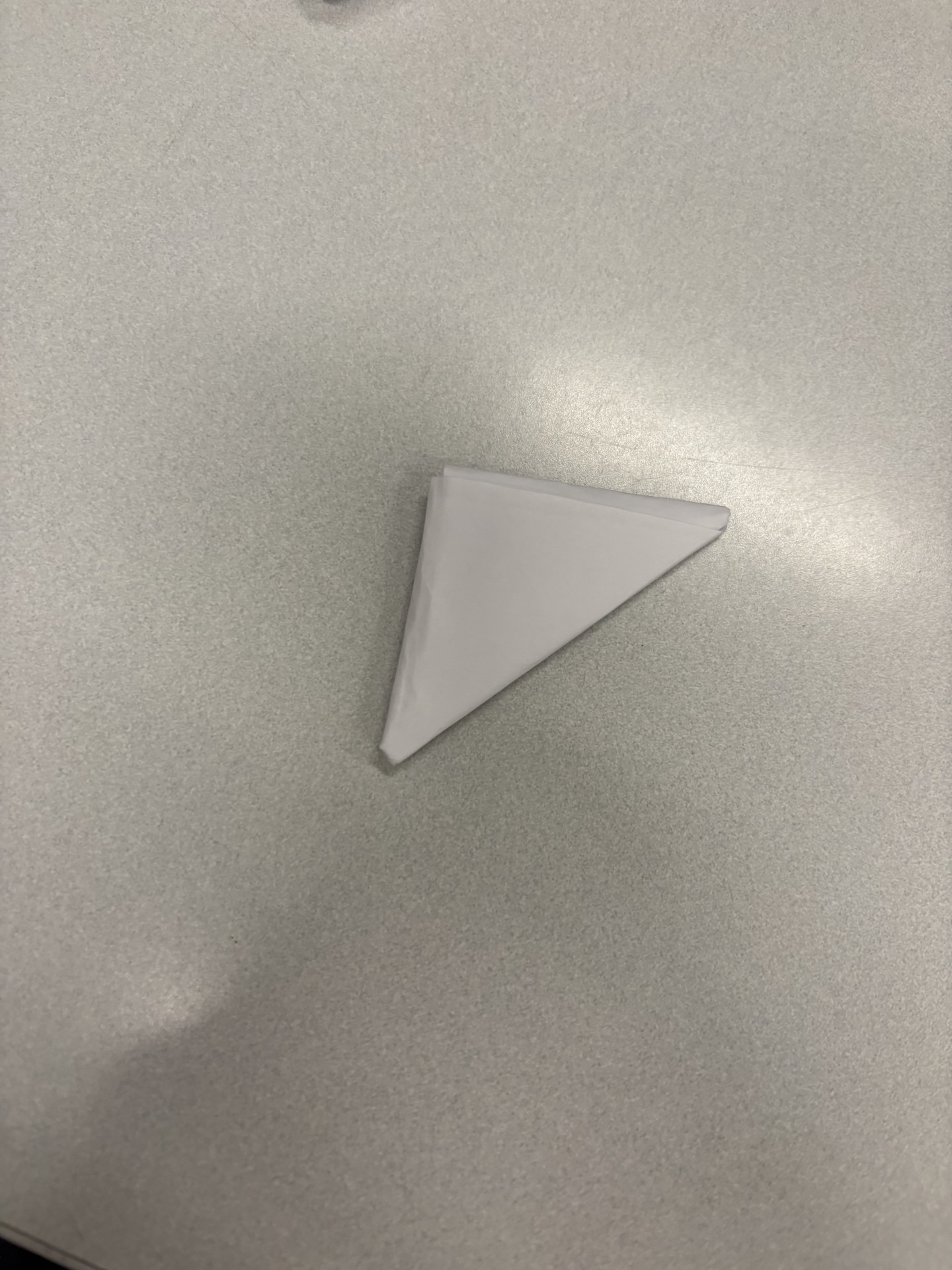
My informant repeatedly folded a standard 8×10 piece of printer paper, ensuring tight, straight folds with no unnecessary creases. The shape is formed by folding triangles into one another, making the final product dense and sturdy. My informant used an older YouTube video for assistance to remind him of some of the steps. He demonstrated the folding process and explained key details, such as the aforementioned tight folds, minimal creases, and common mistakes people make when folding them.

The final result is the Paper football pictured above, which can be used to play a fun game with a friend. Each takes a turn: one holds their fingers in the shape of a goalpost, the other positions the football in a punting position by holding the top corner and pushing down so it stands vertically. The “kicker” then flicks the football, propelling it forward into the goal. The player who gets five goals first wins.

Analysis:

It is interesting that he called it a football. I had never heard it called a paper football before, but when he showed me the process, I immediately knew what he was talking about, which I called a “paper triangle.” It’s funny, because I also learned how to make those from friends back in elementary school. These kinds of foldables often appear when we’re supposed to be learning, paying attention, or otherwise doing something else. Due to their location, students had to be somewhat sneaky when creating or playing with them, keeping them hidden from the teachers.

It is also a perfect representation of school children’s folk art. It is an item made informally from mass-produced materials, that’s taught from student to student, or unofficially online, and holds no monetary value. However, it does hold sentimental and nostalgic memories for the children and communities who grew up with these.

It is also interesting how he used some assistance from a random YouTube video. This reminds us that folklore continues to thrive online. There wasn’t one specific “right” video. Although the end product is roughly the same, each creator has a slightly different way of folding the paper or presenting the instructions, giving the process variety. Even though the digital tutorial exists, he still showed me in person how to make it, and the details (described earlier) he added were quite interesting and different than what the video did or could have mentioned.