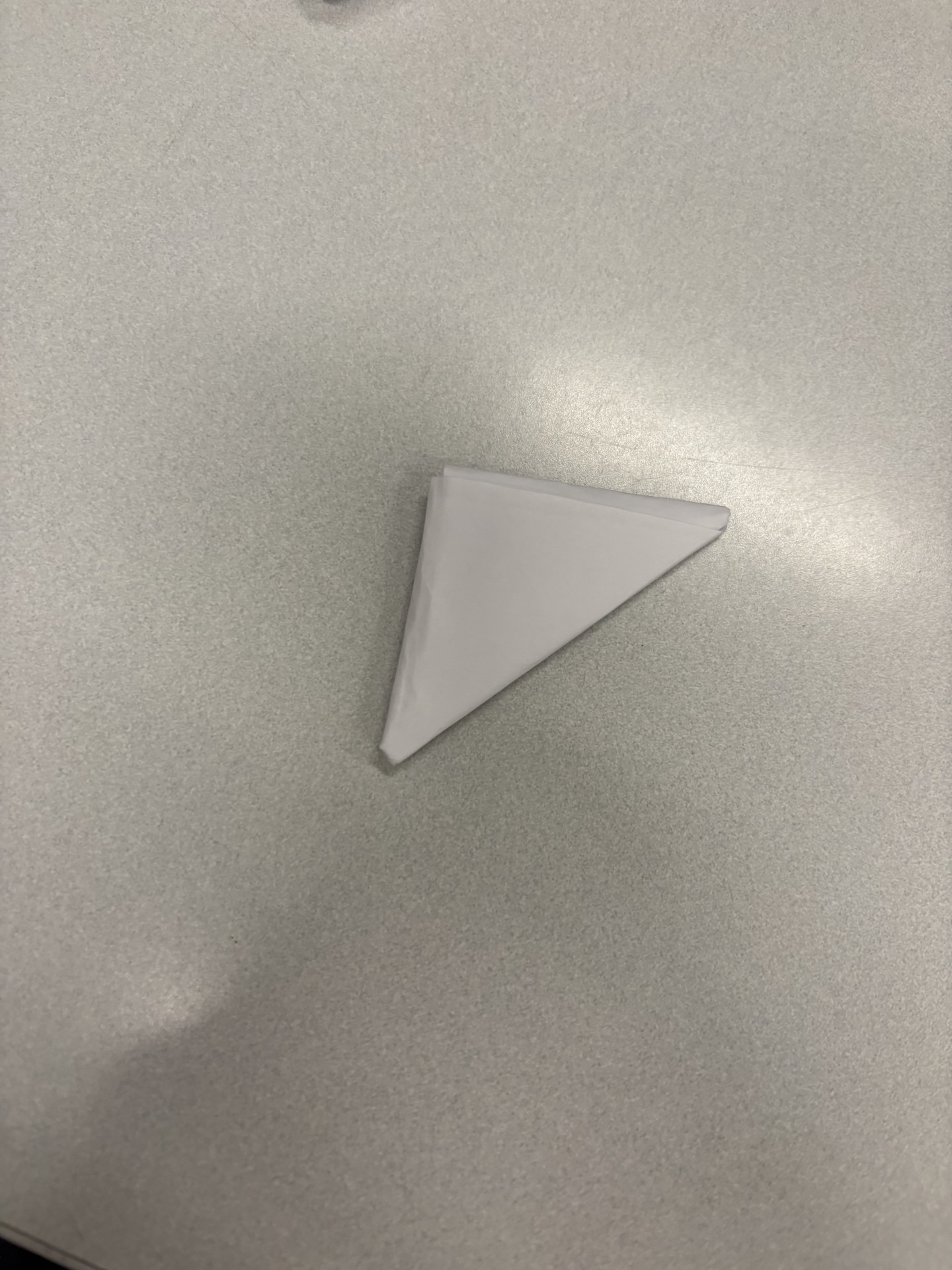
During an in- class activity, my informant showed me how to fold a standard piece of paper into a football that he used to play small desk games with friends as a child. He said said that he learned this in elementary or early middle school and often created these footballs while bored in class. It was a fun way to stay busy and play with friends when class allowed it.
Text:
My informant repeatedly folded a standard 8×10 piece of printer paper, ensuring tight, straight folds with no unnecessary creases. The shape is formed by folding triangles into one another, making the final product dense and sturdy. My informant used an older YouTube video for assistance to remind him of some of the steps. He demonstrated the folding process and explained key details, such as the aforementioned tight folds, minimal creases, and common mistakes people make when folding them.
The final result is the Paper football pictured above, which can be used to play a fun game with a friend. Each takes a turn: one holds their fingers in the shape of a goalpost, the other positions the football in a punting position by holding the top corner and pushing down so it stands vertically. The “kicker” then flicks the football, propelling it forward into the goal. The player who gets five goals first wins.
Analysis:
It is interesting that he called it a football. I had never heard it called a paper football before, but when he showed me the process, I immediately knew what he was talking about, which I called a “paper triangle.” It’s funny, because I also learned how to make those from friends back in elementary school. These kinds of foldables often appear when we’re supposed to be learning, paying attention, or otherwise doing something else. Due to their location, students had to be somewhat sneaky when creating or playing with them, keeping them hidden from the teachers.
It is also a perfect representation of school children’s folk art. It is an item made informally from mass-produced materials, that’s taught from student to student, or unofficially online, and holds no monetary value. However, it does hold sentimental and nostalgic memories for the children and communities who grew up with these.
It is also interesting how he used some assistance from a random YouTube video. This reminds us that folklore continues to thrive online. There wasn’t one specific “right” video. Although the end product is roughly the same, each creator has a slightly different way of folding the paper or presenting the instructions, giving the process variety. Even though the digital tutorial exists, he still showed me in person how to make it, and the details (described earlier) he added were quite interesting and different than what the video did or could have mentioned.
The performance is a telling of the Chinese legend of Chang’e and Houyi told to me by a Chinese international student at USC, who I will refer to as “EY.” We are sitting together outside of Taper Hall discussing legends. EY goes on to explain the legend and its connection to the Mid-Autumn Festival, along with the cultural beliefs associated with the story.
TEXT:
EY: The legend story I’ll be telling you about is called Chang’e’s legend. It is a Chinese legend um that explains where we have or how we have the Mid- Autumn Festival in mid September in China. Umm so the story basically is about like there’s a goddess whose name is Chang’e who kinda like takes a pill and turns into a rabbit that runs to the moon on the day of mid-autumn festival. Nowadays people in China usually have moon cakes on that festival to celebrate Chang’e.
Interviewer: Oh that’s interesting
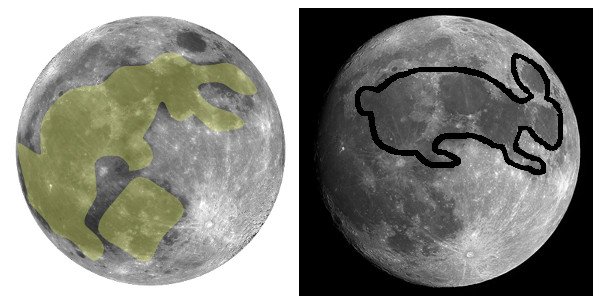
EY: So if you look closely at a picture of the moon, there’s a shade that’s in the shape of a rabbit and so people often see that shade as the picture of Cheng’e. The rabbit shape is Cheng’e.
The longer version of the story is mostly about how previously there’s a god called Houyi who kinda shoots the sun in the sky. Chang’e and Houyi get married to each other. Bu then, Houyi was originally supposed to take a pill but he refused to and like the person who asks him to take the pill hides in their home. When Houyi is out and Cheng’e is home, Cheng’e has no other options but to take the pill. When Houyi returns home, he finds out his wife is gone and he’s sad… He might be sad… He must must be sad.
Interviewer: Probably, he’s probably sad.
EY: Yeah, and so the two are separated and Cheng’e is in the sky.
Interviewer: Okay, that’s cool. Do you think there’s like a metaphor, like a meaning behind the story. A meaning that you or your family and friends associate with it?
EY: Yeah, so it’s mostly about nostalgia and separation, I guess. There’s a metaphor in China where we compare the moon to reunion and a happily ever after.
Interviewer: That’s pretty cool, I never thought of the moon as associated with that before.
EY: And so we can associate the moon with romance or reunion in some sense. In Western [Chinese culture] ideas.
Interviewer: I don’t think that’s very common over here. We don’t typically associate the moon with romance. I think I got the story and the meaning behind it. Is there a personal meaning for you that you take on specifically to that story?
EY: I just felt like the look of the rabbit is very interesting. Yeah if you google a picture of the moon.
*looking up a picture of the moon*
* not the image referenced, but gets the idea*
EY: For example, this part is the rabbit’s head. These two are the ears of the rabbit.
Interviewer: So, I gotta look at it upside down.
EY: Yeah, so this is something that most people don’t usually observe.
Interviewer: Interesting, is that something you can only see at a certain time? Cause there’s different phases of the moon and seasons. Is this something you can only see in September? [The month of the festival].
EY: I guess yeah, but like that time that day is when the moon is like a full moon.
*end of interview
Analysis:
EY explains the story has a significant meaning not just to her, but her family and culture. The story explains the shapes in the moon, gives meaning to culturally significant foods like moon cakes and serves as a fun story to tell. The story is distinctly Chinese and like any cultural story serves as a great reminder for who you are. Without the legend, the mid-autumn festival is really just another holiday. The legend gives the celebration new meaning and amplifies the significance beyond just a fun tradition.
It also gives a standard story to relate to across generations. The culture as a whole can appreciate and enjoy this story. Parents telling their children aren’t just entertaining them. They’re connecting them to their family and culture giving them an identity. It also creates a symbolic meaning that Chinese people can relate to.
EY explained how the story recontextualizes the moon as a symbol of reunion, romance or “happily ever after.” This is interesting because in my culture, the moon doesn’t really mean anything in particular, it’s just the moon. So, to hear how this legend breathes new meaning into the natural world is quite cool. It gives an “everyday” object new culturally significant meaning. In this case, love and reunion. I’m familiar with the idea of roses symbolizing love and affection. But I actually think the moon is better. Unlike a rose, the moon won’t fall apart over time. It might wane, but it always comes back. That makes the reunion and meaning so much more impactful. The same moon can be seen across cities or continents, so it really does connect family and friends. Also, I think there is some more meaning with the moon in that it represents reunion. Every morning, the moon disappears, but we know it’ll come back. That physical movement and repetition adds to meaning that EY explained.
I think that the ritual of eating moon cakes and celebrating during the festival is a way for people to connect with their family, culture, and partners. It’s something that I’ve heard my other friends do, whether they were in China or here in LA. That makes it a cultural signal and reminder of shared belief and identity. It’s given meaning by the story, and eating mooncakes is a way for people to actively participate in that story and culture. The food, story, and importance of the moon itself are great because they can be transmitted anywhere. People can relate to and appreciate that meaning, whether in China or here in America. That story, food, and connection to the moon a ways for people to share their culture without needing to be “at home” for the festival and celebrations. These traditions can be transported and adapted to new regions or environments while maintaining that unique cultural identity.
It’s very interesting to me because, like Houyi, my informant is away from home, separated from loved ones. This must be a very personal story for her, and maybe a very significant one at this moment as well. The legend she chose to share specifically covered longing, separation, and the desire to be together. Whether she meant to or not, the choice to tell that story seems to have been influenced by her feeling away from home; it is probably a way to process her emotions, which is quite cool.
During an in- class fieldwork session, my informant, “NJ” told me a saying and idea popular in Korean culture. He explains two scenarios in which seaweed soup should and should not be eaten, according to Korean folklore. He is Korean American and as far as I know, has lived his whole life here in America.
TEXT:
“Don’t eat seaweed soup before an exam”
Nathan explains that parents warn their kids not to eat food with seaweed such as seaweed soup before an exam. He explained that the slippery soup will cause the information to slip from their head. NJ explained how the idea of eating seaweed soup doesn’t just apply to parents and schoolchildren, but to other areas of life as well. For example, NJ explained that in Korean culture, pregnant women will eat seaweed soup as well. This is done because performers believe that it will help the women have a smoother, easier birth.
He said this is a popular Korean saying. His parents told him as a kid, passing on the saying.
Analysis:
It is an interesting belief that seaweed soup, a slippery dish, should be avoided before big moments. The idea is that it might cause students to slip up or forget what they studied during the exam. The same idea applies to pregnant women, but in this second case, the slippery quality is actually a good thing.
Logically, this belief makes no sense. But, something about it just sounds right. There’s some kind of pseudo logic or vernacular reasoning. If you eat something slippery, you’ll be slippery. The qualities of a food being slippery or sticky don’t actually have much, if any, effect on students’ exam scores or mothers giving birth. But somehow the saying still makes sense. I could imagine that it is especially helpful in moments that are really stressful (exams, pregnancy, etc). These are moments where we can feel anxiety and maybe powerless.
But, the simple saying acts as a illogical solution to get back that control. How do fix something which logic won’t help? Simple, make your own logic. I can imagine that the belief functions similarly to when athletes wear their favorite socks or shoes on game day. It offers a way for people to manage their anxiety and gain a sense of control in high-pressure situations. These superstitions allow performers to channel their anxiety into an easy action (or inaction) so they can feel better prepared for the task. It also lets them relax. In the test example, students who worry about forgetting what they studied can rest assured they won’t. They didn’t eat seaweed soup, so they probably won’t forget.
It’s also interesting that the same quality and food, slippery soup, can have a positive or negative connotation depending on the context. For exams, seaweed soup should be avoided, but for a pregnant woman, seaweed soup is a blessing. What would happen if a pregnant woman were taking an exam? I don’t think the answer matters much because the logic depends more on the context than any actual rules. The family that told their child, or the person who decided to eat soup that day, chooses the meaning. It doesn’t matter whether the rules are accurate or realistic, so long as they are believed in. Belief is what gives them power. For example, my informant NJ doesn’t encounter seaweed soup often here in LA, but he doesn’t avoid slippery foods. But perhaps if he wanted the qualities, then he would choose to believe in them. Or, if he were stressed about an exam, he might consider changing his diet.
Additionally, this is a fun superstition passed from parent to child. This sharing of beliefs and wisdom can bring families closer together. It sounds silly, but a nervous child might easily be calmed by the saying. That relief they feel will bring them closer to their family and make them appreciate the support. Instead of just saying “don’t worry about it, you’ll do great,” they offer a simple solution to make exams more manageable. This could help the children feel supported and cared for while parents support their achievements.
“Whenever you’re going after travel, even if it’s just one day or something, you have to eat dumplings before you go. And when you come back, you eat noodles. Like for the first meal. The meal right before you leave has to be dumplings, and the meal right after you come back has to be noodles. We have a saying that goes “When you get in the car, you eat dumplings. When you get off it, you eat noodles.” It might be a Beijing tradition, but my grandmom is from Shandong, and they still follows this tradition. The dumplings look like small pieces of gold. You have to eat an even number of dumplings. Even numbers are considered luckier than odd numbers. When you come back, you eat noodles, which symbolize that you are attached to your home, because the noodles look like ropes. They held you to your home. Noodles are also not tangled, which simplifies a smooth future and a smooth return home.”
Context:
The informant describes a travel-related food tradition practiced in her family. This tradition is possibly rooted in northern Chinese regions like Beijing and Shandong. Before leaving for a trip, even a short one, the family must eat dumplings, and upon returning, the first meal must be noodles. She learned this practice from her grandmother, who continues to follow it, showing how the tradition is passed down across generations. The informant also explains specific rules, such as eating an even number of dumplings because even numbers are considered lucky. This ritual remains important even when travelling becomes routine. For the informant, it functions as a meaningful way to frame movement away from and back to home.
Analysis:
This tradition shows that everyday practices create a symbolic order. The pairing of dumplings and noodles structures the uncertainty of travel into a predictable and meaningful sequence. Dumplings, shaped like gold, symbolize wealth and a good beginning, while noodles represent connection and continuity, emphasizing a safe return home. The rule of eating even numbers further reflects how ideas of luck and order are embedded in routine actions. These practices turn travel, a potentially uncertain experience, into something culturally organized and emotionally reassuring. Thus, this tradition reinforces values of safety, prosperity, and attachment to home.
This text was collected from a close friend of mine, who shared a photo of a daisy chain she had made. Daisy chain making is a traditional craft in which flower stems are linked together to create a wearable object, typically worn as a crown or bracelet. I learned the technique from a YouTube tutorial and subsequently taught it to my friend in person, who then practiced independently and shared the result. The practice is typically associated with outdoor settings and leisure time, and carries a nostalgic aesthetic. My friend photographed only half of the finished chain, suggesting the image was shared casually and informally rather than as a deliberate documentation of the craft.
Analysis
This piece raises interesting questions about the boundaries of folklore in the digital age. The transmission chain here — YouTube to me to my friend — exemplifies the post-modern collapse between oral and digital culture, where informal skill-sharing that once happened exclusively face-to-face now moves fluidly between online and interpersonal contexts. The YouTuber functions as what Von Sydow would call an active tradition bearer, putting a personal spin on a widely shared traditional craft and broadcasting it to a mass audience, yet the craft itself remains folkloric because it exists in multiplicity and variation and is disseminated informally. The in-person transmission from collector to friend represents the more classical folk process, learning by demonstration and example rather than through any official instruction. This piece also connects to discussions of folklorism: daisy chain making is an ancient craft now circulating through commercial platforms like YouTube, raising questions about whether the folk process is preserved or subtly transformed when it moves through digital spaces. The craft’s persistence across these shifting transmission channels speaks to its deep roots as a form of vernacular, embodied knowledge.