
Category Archives: Rituals, festivals, holidays

Kandi and PLUR

Age: 23

Date Collected: 4/27/2026

Context:

My roommate and good friend of three years is involved in the rave scene here in LA. He does operations for one of the largest hard techno organizations in California. He is mostly involved in the hard techno scene, but occasionally he goes to festivals and dub shows where passing out kandi bracelets (pronounced “candy”) is more popular. He showed me his collection of goodies he’s gotten in his 5 years raving, and these stood out to me.

Text:

Kandi bracelets are a great representation of the exciting and friendly rave scene. Kandi are handmade elastic bands made of colorful plastic pony beads, featuring fun messages, images, or small items tied to them. Some of them are quite complicated, including finger designs, while others are quite large and stretch up the arm. The most common, though, are simple bands with funny messages or jokes. My friend explained that “they’re connected to the dub, trance, and outdoor-festival communities.” You can see kandi passed around at mainstream shows like Tomorrowland, Lollapalooza, or Electric Daisy Carnival. Those festivals are during the day, when you can get away with lighter clothing and show off your kandi. People wear loose clothes with bright clothing to match the fun color of their kandis. My friend has gotten several kandi bands at Outside Lands, smaller Afro house shows, and other events with chill crowds. Its normal to give kandi to people you like or just feel a positive vibe from.

He mentioned that there’s a specific ritual to giving them away. The PLUR (Peace, Love, Unity, Respect) handshake is the way ravers exchange their kandi. He learned it from someone when they came up to him and gave one to him. He showed me holding up a peace sign, and I held up a peace sign to his hand. “To the beat, you dance around. Then you make half a heart shape.” I completed the heart for “love.” Now, you place your palms together his for “unity,” like a high five.” Finally, we interlocked fingers for “respect.” At that point, the initiating raver would pull one of their kandi bracelets from their arm, over their hands to their arm, all while their fingers are still interlaced. All this is done to the beat of the music, or in a fun flow state. Then you should pass one of your kandis over your arm to theirs. Then you can dance around and either part ways or make a new friend. But “you don’t need to actually give any back; people just want to give them out.” For example, my friend never brings kandi to shows; he doesn’t make them either, yet he has gotten around five from his time raving and has built up quite a collection. He doesn’t wear them to shows because, well, mostly they aren’t his style. But also because kandi bracelets are not common or popular at the shows he goes to. They are more associated with the mainstream EDM scene. He goes to underground techno shows, which are typically held at night and where kandi is far less common.

People trade them, give them away, and they are all made by hand independently. He doesn’t really remember who gave them to him; he was just enjoying the music. All the ones he has are very unique, and no two look really all that similar. He told me they’re all usually unique and like a fingerprint. Each artist has their own style. People try not to copy one another, and they all try to have unique ones so that you can remember that show or specific interaction. As you can see from the picture, they’re all made from relatively cheap beads and elastic string from Amazon or a craft store, yet each seems to have a unique bead pattern, color choice, and style. There’s one that says “sploinky” (no real meaning, just fun). Another says “xing”, which probably stands for crossing the threshold or barrier, and tripping. The final one says “cum bucket,” which was given to him by a girl. This highlights the ironic and really funny humor at these shows. There’s even one with a pacifier on it, which you can use if you’re grinding your teeth. Very practical. Another, pictured above, is pink and star-shaped and goes over the back of your palm. That one is great if you are wearing long sleeves or want a full sleeve of kandi.

Analysis:

Out of his collection, these stood out to me. I immediately thought of them as folk art and, more specifically, I think they are a perfect example of bricolage. They are made of mass-produced items recombined to create something new. These items aren’t meant to sell; they have no real monetary value. But, they do have sentimental value. One of their main purposes is to serve as a physical reminder of your great time at a show or of a new friend you made. Each Kandi is given new meaning based on the context in which it is given. They are also deeply rooted in the festival and mainstream EDM scenes, and associated with rave culture at large. To me, they’re instantly recognizable as a great folk element of that scene that was made by the people. A company, the festival organization, for instance, can’t profit from or poach these Kandi. They’re just beads and string. Any unique bead design could be made by a raver using a 3d printer at a public library. I don’t think it could really be commodified easily. There is also a paradox that something sentimental or valuable is made out of such cheap materials. It’s funny because it reminds me of a crappy macaroni plate a kid makes for their parent’s birthday. Each individual piece is worthless; even together, it isn’t that valuable. But to ravers, these are memories. They hold so much individual value because of the context in which they were given. If my friend gave me a Kandi just for fun or sold one to me, I probably wouldn’t care as much as if I had gotten my own at a show. So the context is the value, a company can’t easily replicate that or profit off of it, which ensures it is of the people and for them.

Aside from being a tangible record of interactions, they also serve as a way to build community. I mentioned that these are very common in the mainstream scene. They’re bright, colorful, fun, and inviting. They help create bonds between ravers and give people an opportunity to connect. This is especially important because at these venues, the music is very, very loud. People wear earplugs or AirPods to protect their hearing. That makes casual conversation and small talk really hard. So, the kandi gives you an easy way and a reason to approach a stranger who is part of your community. It is also very helpful in the mainstream scene, since new ravers or shy people might be uncomfortable. But if they’re given a Kandi, that be like inviting them into the fold. They could feel valued and seen and a member of the community which is really cool and helps keep the scene thriving and positive.

Aside from the purity of the folk art, the PLUR handshake is also a great example of how folk gestures are taught and learned in real time. He said he felt a little confused, but he got the idea pretty quickly. I had a similar experience. The PLUR gesture also highlights the friendly vibes that rave scenes go for. The acronym isn’t just for fun, its a code. To be part of that culture, you need to be peaceful, show others love and respect, and be unified. The community really does care about being respectful. To the shows I have personally been to with him, I’d say they were far more respectful than your average line at Walmart or Disneyland. The PLUR is a great acronym that effectively sums up the values and code of the rave scene into one fun gesture. Its a great way to teach new members and remind old ravers what’s important.
Bengali New Year – Pohela Boishakh

Age: 25

Date Collected 4/21/2026

Context:

A good friend of mine, who immigrated with his family from Bangladesh for college, told me about the Bengali New Year celebration, “Pohela Boishakh” or পহেলা বৈশাখ. He told me about the general celebration and how his family’s celebrations differed from the norm.

Text:

On April 14th, “my family wakes up, we dress in red or white, and eat this fermented rice, mashed potatoes, and hilsa fish.” He explained to me that he thinks the white represents purity, and red represents joy or energy. But to him, the colors really symbolize the spirit of the new year and the celebration of Bangladesh. He tells me that breakfast typically consists of mashed foods, lots of vegetables, and starches, with a single piece of hilsa fish. He explained that the Hilsa fish is Bangladesh’s national fish and a cultural icon. When he was young, his family taught him that’s the way things are done, but he never really questioned it until he came to America and learned about our traditions. He explained that as he got older, his family stopped making the fermented rice (which would actually get you a bit drunk). For them, it was just a tradition that his parents wanted to pass down to him and his sister, “kind of like hunting for easter eggs.”

After the breakfast, the celebration isn’t over. They move to the streets, painted red and white. Parades go through the streets and people celebrate kind of like a big picnic. He explained it was “similar to the Marty Gras,” but without all the alcohol or debauchery. But a similar level of excitement, fun, celebrations and an almost parade like atmosphere. His celebration was quite different from those in the big cities, where they used parade floats and giant symbolic animal heads. In the countryside, things were simpler, and people would set up around the grass at parks and visit each other’s setups. It was a time for old friends to connect. He mentioned his dad’s old soccer friends had a spot at a local park they would revisit every year. Lunch continued the excitement and festivities with street food or barbecue-style setups. The countryside differed from the city in that the focus was on building community rather than on the nation or on symbolic ideas.

The celebration would continue throughout the day and into the night; families return home and enjoy an intimate family meal with fish, lentils, and, of course, rice. He explained that typically, the women would stay back or leave the celebrations early to cook and prepare the family dinner. Sometimes they would be able to take rotations, but unlikely. He explained that in his family, most of the cooking was done the night before, so there was maybe like an hour of work to do, and he would return home to help his mom and sister cook. To him, the festival was patriotic and a way to unite as a community, to remember his identity and beliefs, and honor his family and traditions.

Analysis:

The story was very interesting to me; it sounds similar to the festivals and events I’m familiar with, but at the same time, so different. The rice and a single slice of fish remind me of an almost religious practice because it is so specific and symbolic. But the practice is regional, not religious; people in India, including West Bengal, also celebrate it. I found it funny because my friend is a devout Muslim who refuses to drink when we go out. So, his telling me that the fermented rice got him buzzed had me feeling betrayed. But, he told me that “it’s nothing and doesn’t count as a sin.” This was very interesting and makes me think that aspects of the celebration, like the fermented rice must predate the country’s Islamic influence.

In addition, the meal seems to be a symbolic fresh start to the year. The rice and slice of fish are humble and could represent a simple style of living, or starting the year humbly. The fish, also the national fish of Bangladesh, suggests that including fish conveys national pride and recognition of the country.

My friend also mentioned a lot of details that he wasn’t sure about some of the traditions. He knew what they were and how to do them, but he never really considered why. They were just his way of life. His normal. It wasn’t until he experienced new cultures in coming to America that he began to think about why.

In addition the traditions aren’t static, they adapt. Fir instance he joined his mom and sister in cooking, and as he’s grown older, they no longer eat the rice. This just goes to show how traditions can change over time. As other cultures and norms change, some traditions might be viewed as less important, childish, or outdated, and may be cut or replaced by new traditions.

The costumes (red and white clothing) serve to show who is participating in the holiday. They serve as a physical representation of membership in the folk group, community, and celebration. They have symbolic significance, but my friend didn’t focus on the colors’ meaning. What mattered to him was that the colors represented Bangladesh and, more specifically, the country’s holiday. The same could be said about the hilsa fish and fermented rice. The meaning of each individual piece might not be significant or known to every participant, but the larger cultural meaning of being Bangladeshi and “in” on the tradition is where the meaning lies.

I also found that Dhaka’s procession, animal floats and general celebration style is protected under UNESCO, but not the holiday itself.

After moving to LA, he and his family had to change their traditions even more. He said that the celebrations are fragmented. Despite the large Bangladeshi population in K-town, it seems most celebrations are held at home and don’t last as long as they do back home. This shows how, as cultures and ideas spread to new communities, they must change and adapt to those communities. It seems the Bengali population in K-town is not unified yet to come together as a community and celebrate. But, it could also be because K-town isn’t “home.” His family just immigrated fairly recently, so they don’t have the same communal bonds they had back home. So that could be a factor as well. In LA, the family becomes the folk group, whereas back home, it was the community or even the nation as a whole.

The Shotgun

Age: 21

Collected 4/22/2026

Context:

My roommate, who is of Irish-American descent, told me the story of when he first went shooting. We met in high school and have been friends for about 8 years now. He told me in our apartment kitchen after asking about his family traditions.

Text:

His family first immigrated to New York in the 1800s. About a century later, he told me that his great-grandpa bought a “classic Baretta double-barreled shotgun like you’d see in Red Dead” for hunting ducks in Maryland. Nowadays, my roommate and his dad often go hunting in the woods in Montana, and he fondly remembers that core memory with his dad of when he first learned to shoot.

My roommate told me that back when he was 15, his dad took him to a gun range in Lake Piru, California, to learn how to shoot. The event wasn’t specifically on his birthday or any particular day, as he can remember. But it was sometime soon after he turned 15. In his family, “each male for the last 3 generations has learned to shoot the same double-barreled shotgun.” The shotgun is a family heirloom that he suspects his Irish immigrant great-great-grandfather bought, for hunting and it’s been passed down steadily from father to son.

While at the range, his dad started with gun safety. Essentially, just the basics, like “don’t aim it at people or things you don’t wanna shoot.” He also learned to respect the weapon, “don’t treat it like a toy,” and not to throw it around or handle it roughly. As far as he knows, the shotgun has been largely kept in good condition, and most, if not all, of the parts are original. The wood stock and grip are lacquered with oils to keep it clean and in good condition. When it finally came time to shoot, his father showed him how to stand and helped him aim. When he pulled the trigger, the gun went off, but he found out that it was loaded with a blank. He told me that he and his dad first shot a blank to get a feel for the recoil.

After handling the recoil, he began to shoot at the clay pigeons launched in the air at the range. He said his dad wanted to teach him how to hunt, so moving targets were a great way to get into it. After shooting, he explained that his dad showed him how to clean and take care of the gun. Later, when he turned 18, he was allowed to have his own gun under different state laws. He hasn’t shot the shotgun since; it serves as a ceremonial piece.

I asked him if there was a specific time or moment when he learned, but he can’t remember. But he did say it was a moment when he started to feel more grown up. He told me that his sister also learned how to shoot. He couldn’t say whether she got the exact same treatment. But their father took her to a local range and taught her to shoot the same shotgun.

I asked if he would continue the tradition. He told me “that he plans to “of- course man.” The shotgun will be passed to him and he plans to pass it to his kids when they’re born and ready. He feels that the passing of the shotgun and the instruction in how to shoot are a metaphor for life. He and his family “value being responsible and self-sufficient.” He said it felt pretty special to be the fifth in his family to hold and shoot the gun. As the sole male child and heir to the family name, he felt it was a really special moment to step into the shoes that his family had left. To fulfill expectations and continue the legacy.

Analysis:

This was a cool story to hear; my roommate hadn’t told me about it before, and I’ve known him for around 8 years now. It was a pretty nice story and makes sense because his family has a strong military background dating back 3 generations. Shooting, hunting, gun safety, and responsibility are all very important to him and to his family.

I think the ritual serves three main functions besides bonding. The first and more obvious is that the ritual serves as a lesson in gun safety. It’s a father teaching his son how to properly hold and shoot a weapon. He learned discipline and responsibility, and it made him interested in the responsible use of weapons at a young age. It teaches real safety skills for young people and taught him the power and potential danger of weapons.

I think an equally important purpose for this event is to serve as a passing of the family legacy. Family is a big thing for him; he cares a lot about that lineage and is proud of where he comes from. The fact that the same gun has been used by all the males in his family says a lot. It is their legacy, their transition into adulthood, and their father passed that legacy to him so he could learn what it means to be a male in their family. His sister also learned and got the same experience. But my roommate said she isn’t as interested in the legacy, shooting, or the shotgun as he is. Also, he will inherit the weapon, not his sister. By learning with that gun, he is an active participant in that tradition and now a part of that shared family history. He remarked that it felt really special to him to be part of that. I asked him, and he explained that he did have a connection to that story. But for him, the most important thing it did for him was teach him responsibility.

The gun itself is also a physical representation of that legacy. It has existed for over a century and serves as a marker of his family. Sure, other guns exist, but this is his family’s gun. He adds meaning to it by using it, continuing that legacy, and being interested in teaching his children how to shoot that gun.

A final, deeper meaning is that the lesson served as a rite of passage for young men in his family. In a way, it created a liminal space to help facilitate the transition of children to young men. The lessons it taught him about weapon safety carry over to real life. Being disciplined, respectful, self-sufficient, and responsible are all qualities that he holds dear. He and I agree that those values probably stem from the family’s deep military history. Those are all imparted to him through that event.

It’s also interesting to me that I just found out about this. I knew he knew how to shoot, but I didn’t know it was such a significant family tradition. I know a lot about him since we’ve known each other for 8 years, but that story seems to be sacred and personal. It’s also funny because at first glance, my friend doesn’t look like someone who would have traditions. He grew up in a suburban neighborhood in what our other roommate would call a “boring” neighborhood. But this just showed me how much folklore and culture are lying just under the surface. I’ve known him for so long, but all I had to do was ask, and it seemed there was more to my friend that I hadn’t learned.

It also challenges my pre-existing notion that folklore is foreign or unique to a specific identity. Folklore is all around us; we just forget to pay attention because it’s “normal” or we’re used to it. I mean, this is a dude who’s got red, white, and blue coursing through his veins, and yet he has some great traditions. This is just a great reminder that folklore is often studied from a distance because the stuff close to us blends so well into our daily lives.

Folded Paper Football

Age: 20

Collection Date: 04/09/2026

Context:

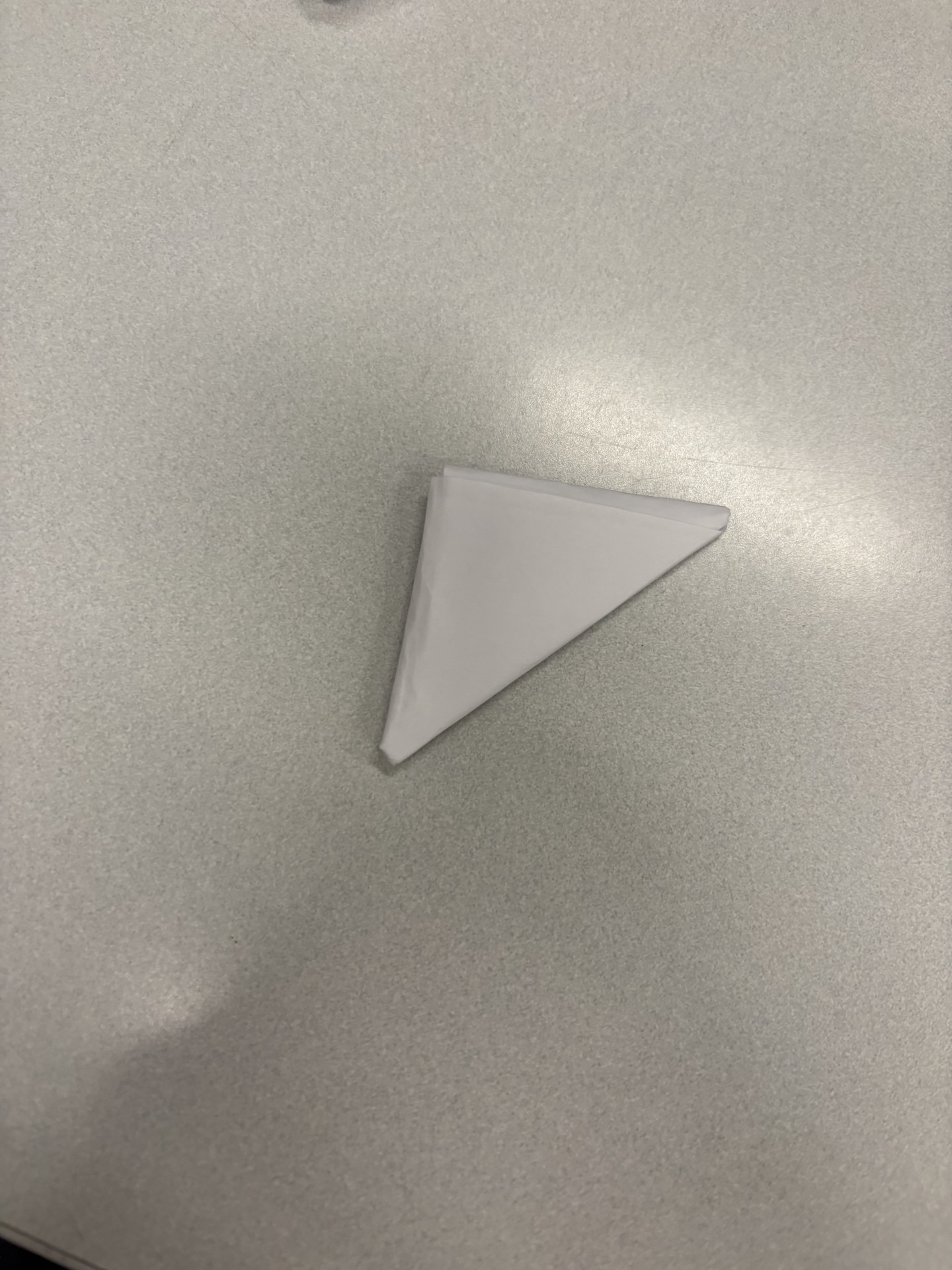
During an in- class activity, my informant showed me how to fold a standard piece of paper into a football that he used to play small desk games with friends as a child. He said said that he learned this in elementary or early middle school and often created these footballs while bored in class. It was a fun way to stay busy and play with friends when class allowed it.

Text:

My informant repeatedly folded a standard 8×10 piece of printer paper, ensuring tight, straight folds with no unnecessary creases. The shape is formed by folding triangles into one another, making the final product dense and sturdy. My informant used an older YouTube video for assistance to remind him of some of the steps. He demonstrated the folding process and explained key details, such as the aforementioned tight folds, minimal creases, and common mistakes people make when folding them.

The final result is the Paper football pictured above, which can be used to play a fun game with a friend. Each takes a turn: one holds their fingers in the shape of a goalpost, the other positions the football in a punting position by holding the top corner and pushing down so it stands vertically. The “kicker” then flicks the football, propelling it forward into the goal. The player who gets five goals first wins.

Analysis:

It is interesting that he called it a football. I had never heard it called a paper football before, but when he showed me the process, I immediately knew what he was talking about, which I called a “paper triangle.” It’s funny, because I also learned how to make those from friends back in elementary school. These kinds of foldables often appear when we’re supposed to be learning, paying attention, or otherwise doing something else. Due to their location, students had to be somewhat sneaky when creating or playing with them, keeping them hidden from the teachers.

It is also a perfect representation of school children’s folk art. It is an item made informally from mass-produced materials, that’s taught from student to student, or unofficially online, and holds no monetary value. However, it does hold sentimental and nostalgic memories for the children and communities who grew up with these.

It is also interesting how he used some assistance from a random YouTube video. This reminds us that folklore continues to thrive online. There wasn’t one specific “right” video. Although the end product is roughly the same, each creator has a slightly different way of folding the paper or presenting the instructions, giving the process variety. Even though the digital tutorial exists, he still showed me in person how to make it, and the details (described earlier) he added were quite interesting and different than what the video did or could have mentioned.

“St. Fratties Day” Celebration – Cal Poly San Louis Obispo

Age: 22

Date Collected 4/16/2026

Context:

My informant is a close friend of mine attending Cal Poly San Louis Obispo. She is a graduating senior and an active member in a sorority. She told me about Cal Poly SLO’s most recognizable holiday, “St. Fratties Day.” When I went to college in Santa Barbara, I knew all about St. Fratties day, but I never got the opportunity to go.

Text:

“Every year on March 17th, we wake up at 3:17, get dressed in our “greenest” outfits, take a green Jello shot, and hit the block parties.” That’s been the tradition long before my friend first enrolled at Cal Poly SLO, but it seems the traditions are changing.

To my informant, this is a uniquely SLO festival that’s shared with students all over California; students come from neighboring schools to attend, similar to UCSB’s Deltopia to celebrate. Typically, students indulge in “Irish like drinks – Guinness, Irish Whiskey, Baileys, Green colored mixed drinks and of course green Jello shots,” “anything that seems remotely Irish is there.” More recently, my informant explained that students come dressed in custom green t-shirts painted with white paint and patched. Like four leaf clovers or messages like “kiss me, I’m Irish” or “I love Irish goodbyes.” About two years ago, students made their own green “borgs” decorated with on- theme messages funny quotes or Irish themed puns.

The holiday has been largely student- run, consisting of massive block parties where certain streets of the town are packed full of students celebrating. House parties, local band performances and pre-games litter the surrounding neighborhoods as students prepare to gather on Hathaway street at 5am. Most students hear about the event through word of mouth, as it is quite popular; if not through friends, they see posts on social media discussing house parties or cover charges for bands. But it seems the tradition is about to change significantly.

Last year, the school started its own concert music festival on campus to divert attention from the neighborhood street parties. My informant told me that this is largely due to the resulting property damage, noise and underage drinking that occurs. In the 2025 celebration, roofs caved in and fences were toppled over by the mass of people.

My informant explained that while in the middle of the crowd she “literally thought I might die.” But, thats part of the fun. Regardless, she explained, the surrounding neighborhood, police, and other officials have placed pressure on the school to make St. Fratties less damaging for the community. So, as a result the school offered a music festival free of entry that has big names performing. My informant explained that the school and community’s goal is to make the block parties illegal and push students towards more “responsible and respectful” celebrations. Additionally, next year, the school is going to switch to semesters, so St. Fratties weekend will fall under their Spring break. My informant believes that “this is their [school and officials] path to totally killing it.”

This last March (2026) the streets were barricaded, with cops on horses preventing students from moving around. So, this exciting student tradition might not exist for much longer, which is sad for my informant and future generations of SLO students. This is a huge event for the students at SLO. They look forward to it, and it is a way for them to communicate their identity as SLO students and show off their campus and student life to friends from out of town. To them, this isn’t just a big party, its part of their life. The event takes a lot of energy from the students as well. Setting up, planning, coordinating their individual contributions and plans. It also takes place on “dead week,” or the week before their finals for the quarter. So, there is a significant cost for dedicated students to fully commit or even attend the event.


My informant explained that after the initial rush, around seven or eight in the morning, she and her friends go back to their house and sleep in the sun by the pool. They rest, get some work done then go out again later that night to the bars in town, which have green decorations, themed drinks and the bands performing. This is where the student population joins the rest of the community, because both students and adults are all out celebrating at the bars.

Analysis:

This event shows a lot about student identity and how events and festivals become a core part of students’ on-campus life. The community comes together to celebrate, meet one another, and enjoy being around one another. It’s an event where groups that otherwise might not interact can mingle and find common ground. It is a way to let go and be free of the difficulties of school for a moment. To release your tension before the push from finals. But also, in a way, a means to challenge the system. Students defy their obligations to study for finals to take part in this event. This is by definition the carnivalesque. An act that defies the “dominant” or regular system of the academic calendar by providing a day to suspend those roles as students. It is especially poignant because it takes place at the highest stakes moment of the quarter, right before finals week.

It also has ritualistic elements, like waking up at 3:17 am (3:17 = March 17th) and drinking Jello shots. This crates a shared “starting point” that all students can enter this event. Brutal as it may be in the moment, it is a fond memory of my informant and shows that students are committed to this event because there’s a “barrier to enter.” These are things that students wouldn’t normally do, waking up that early or drink the Jello shots. But under the context of the event, these things have meaning created by the culture and traditions passed on by older students.

It has been sad to hear about how the school and institutions are in effect “killing” the event. Switching to the semester system means everyone will likely be free from school and away on break. The holiday needs a place, that place and community are removed for the period of St. Fratties. There are risks for the event- students getting hurt, property damage, and noise, to name a few. But, I don’t think killing the event totally is a fair or beneficial solution. The event has become part of SLO’s identity, and students look forward to it every year. Even though they are offering a festival, my informant explained it was poorly run and wasn’t as fun or unique as the block parties. We learned this is called fakelore. An institutional ripoff trying to build on the authenticity of the people’s culture. My friend explained that it felt forced rather than natural. As an outsider, I’m upset by this. It’s like getting a YouTube video interrupted by a corny corporate ad that’s trying too hard to fit in. It also eliminated the house parties, random interactions, and smaller local student bands. When the day becomes just a performance, the students aren’t active participants; they become more like an audience. This institutional replica of the event highlights how the culture and specifics of the event are sanitized by larger corporations to create a mass-produced event. There are thousands of music festivals every year, but only one St. Fratties day.